Wild Herb Ways,
Wild Grass Road, ᚹᛁᛚᛞ ᚺᛖᚱᛒ ᚹᚨᛁᛊ A magical realist novel by Paul Mansky. A bioregion embodying the spirit of life. Folklore first! Ancestor worship
Qigong Wild Grass Road, nourishes vitality Let's learn together about Qigong, a method for nourishing vitality and achieving mutual benefit. 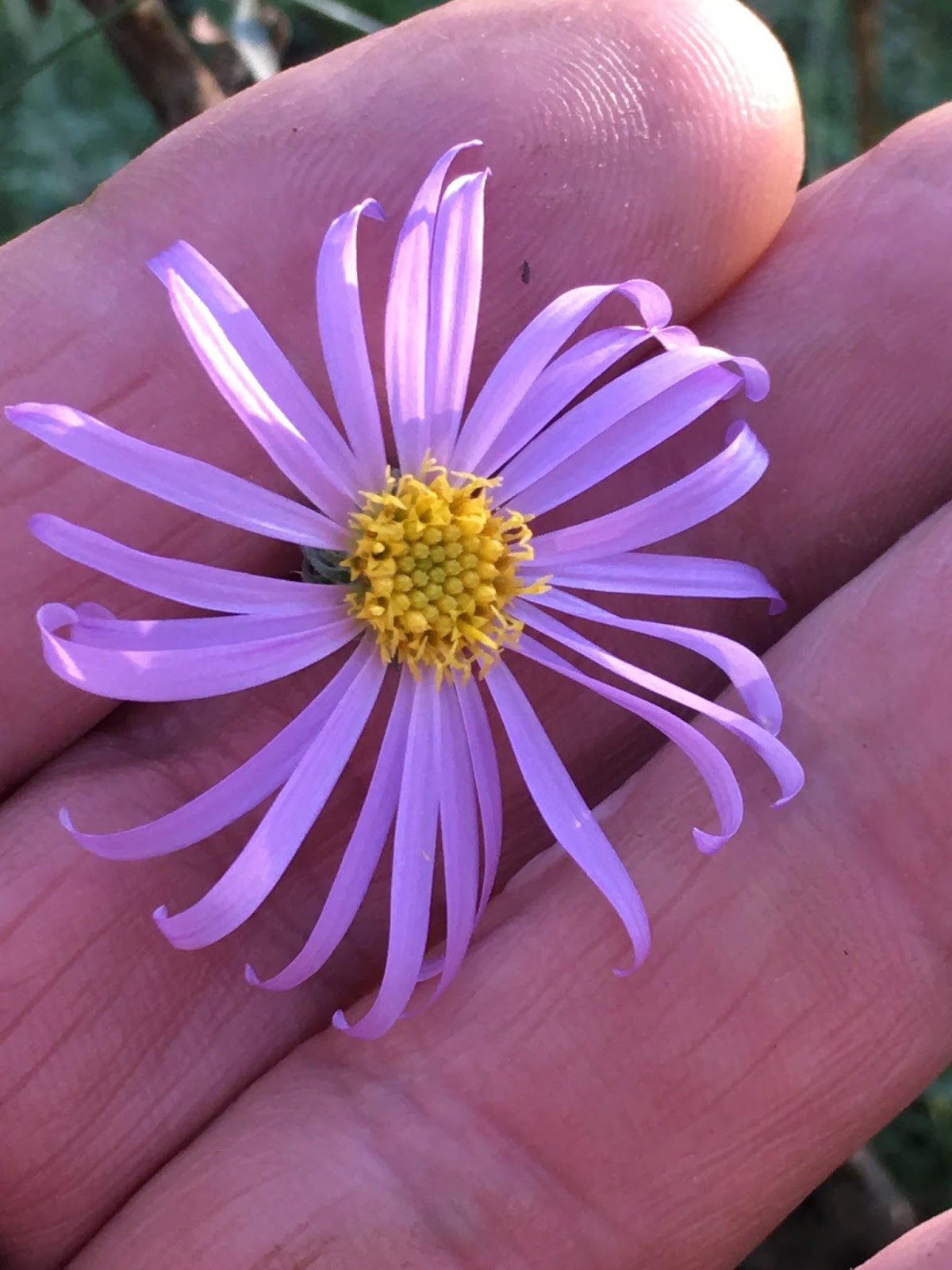
The question arises: what is Qigong? Qigong, also spelled "chi-gong" or "chi-gong," pronounced "chee gung," with gentle vowels and consonants. Qigong is the vitality of mutually beneficial friendship, the ultimate experience of friendship, because everything we do is mutually beneficial. We are intimately connected to experience, and when we cease to nourish our fundamental roots, the tree withers. The ideal of altruism degenerates into an unsustainable, pathological altruism. The best way for us to help each other is to nourish our fundamental life spirit, the essence of giving and receiving in the world of life. There is no pushing without pushing; all things are interconnected through mutually beneficial relationships, and this relationship is nourishment. Previously, in pinyin-based Chinese, it was called "ch'i kung," but now it's called "qigong." Etymologically, these two characters are "qi" and "gong." "Qi" or "chi" refers to rice and steam, thus representing nourishment; "steam" represents heat and fire. Rice nourishes the body, just as people grow grains and then cook them with steam. "Qi" (or "qi") is thus extended to mean not only the body but also the life energy of the entire world, broadly referring to the biological realm and more specifically to our human body. The word "gong" (or "gong") originates from a carpenter's ruler and plow. Etymologically, both the ruler and plow are human tools held by hand; "gong" refers to actual labor, that is, creation or achievement. Therefore, these two characters, "qi" (氣), now primarily refer to nourishing life energy, while the square ruler is used to determine the correct angles in architecture, and the plow is used for farming. Both are related to achievement and are essential for survival. Just like kung fu (or "gonggong"), you may have heard of kung fu or seen kung fu action adventure movies starring Bruce Lee. You might be surprised to find that the two words kung fu and qigong—"gong" and "gong" are the same Chinese character—both refer to skills, learning, diligence, achievement, and practice, such as art forms like ballet and painting, obtaining a university or nursing degree, attending prenatal classes to learn how to prepare for childbirth and care for your first baby, or equestrian sports like horseback riding, and have absolutely nothing to do with kicking someone in the head or striking their nose with an elbow. For some reason, in certain circles, breaking someone's nose, learning how to cause traumatic brain injury, and watching them fall to the ground seems more entertaining than attending the International Breastfeeding Association's Lamaze method of childbirth course.
What does Qigong mean? I define "Qi" as the nourishment of life energy, and "Gong" refers to diligent effort, ultimately achieving mutual benefit. Therefore, the core of Qigong lies in nourishing life energy, thereby achieving mutual benefit. This process of nourishing life energy contains some basic positive cognition, that is, prediction. Usually, people regard prediction as a spontaneous, erroneous cognition and evaluate it negatively. However, all learning is based on making assumptions and quick judgments. For example, if you smell smoke, you might think: I'd better go check it out. What is that smell? What's burning? Did I forget to turn off the stove? Where is the smoke coming from? Is it firewood for grilling, or something dangerous? When you see a flame, you immediately recall past experiences: flames are hot. Therefore, quick judgment is a good thing; it demonstrates wisdom. When you buy a new appliance, it comes in a box wrapped in thick plastic film, and inside is a user manual showing you how to assemble, maintain, and so on. Our lives don't have perfect user manuals, even though we are increasingly surrounded by plastic. Some so-called "official user manuals" are also filled with much questionable information.
The first conception about Qigong is that, under current conditions, our lives mean being dependent on the physical body and rooted in the human form. Therefore, most of our work as humans is related to maintaining and nourishing the body. The concept of nourishment is the correct nourishment through mutual benefit. Mutual benefit means nourishing life. Clearly, plants are living organisms, and the metaphor of caring for plants also applies to Qigong, that is, practicing nourishing life. Plants primarily live in the broader external world; for example, there might be a dense pine forest on a mountain. Along a watershed, there are riparian zones where deciduous trees grow. All these plants in the forest are adapted to the ecosystem of their respective bioregions. Humans are born with the instinct to care for and nourish things. People enjoy cherishing beautiful things. In all these nourishing tendencies, there lies a mutually beneficial relationship. Thus, someone might care for and feed chickens. Besides the beauty of chickens and the sight of them playing, we also care for them through disease, hot summers, and cold winters. Chickens eat insects, utilize kitchen waste, and provide fertilizer to improve the soil—all mutually beneficial. Chickens also produce meat and eggs, another form of nutritional reciprocity. Of course, plants, like gardening, provide nutrition and many benefits. We have fruits and vegetables to nourish our bodies. There are also medicinal herbs with healing properties, such as elderberry, mullein, angelica, coneflower, and rosehip. Gardening also provides nutrition. Trees provide shade and shelter from the wind. Flowers are pleasing to the eye and fragrant, creating a mutually beneficial relationship. We can bring plants into our living spaces to nourish our minds and bodies. Even in hot, arid desert regions like Tucson, we can grow pines like the Afghan Mediterranean pine (Pinus brutia eldarica), with its reddish, rough bark and double needles, perfectly suited to the hot climate of the American Southwest. Therefore, we can use our skills to bring beauty into our spaces, achieving a win-win situation. When we grow plants like hedera (Hedera helix) indoors, we enjoy its beauty while simultaneously reaping the dual benefits of removing harmful indoor pollutants such as nitrogen dioxide, mold, formaldehyde, and benzene. Growing ivy as an indoor plant allows you to enjoy its powerful herbal benefits, especially for the respiratory system. In Traditional Chinese Medicine (TCM), ivy is called "Changchun Teng" (长春藤). It has the effects of dispelling wind, drying dampness, nourishing the liver, and strengthening the spleen and lungs. Whether used in Western or Chinese medicine, it is used to treat cough with phlegm; although it has antispasmodic effects, it can also promote expectoration. Ivy belongs to the Araliaceae family, the same family as other plants beneficial to the respiratory system, such as Nardostachys japonica. TCM usually uses multiple herbs, so it is very rare to use a single herb alone. Herbs are always used in combination in a monarch-minister-assistant-adjuvant manner, mutually benefiting each other; this monarch-minister-assistant-adjuvant combination is also known as monarch-minister-assistant-adjuvant.

A simplified example of this concept in scientific research is a formulation from the European Medicines Agency (EMA) that has been tested and proven effective. This formulation contains common herbs: marshmallow (a throat lozenge), London arugula (a pungent, warming mustard-like herb), and ivy, which are combined to treat coughs, winter colds, and sinusitis. There is a tendency to study herbs, referring to them as "scientific," "scientific," or "peer-reviewed," in an attempt to quantify standardized single chemical components. In the so-called "universal science" approach, many documented tests are confined to this singular, isolated (in Western terminology) "free" method. The emphasis is always on "free," that is, the substance separated from its matrix. This is the opposition between "matter" and "process." The "mutually beneficial life nourishment" approach is based on overall vitality, not on strong "physical" components. Therefore, herbs cannot replace single-component compound medicines. Herbs are living plants with life-nourishing properties. For example, in a 2019-2021 evaluation, the following herb combinations showed significant effects: marshmallow (Althaea of ficinalis), myrrh (Commiphora molmol), licorice (Glycyrrhiza glabra), ivy (Hedera helix), ginger, and elderberry (Sambucus and elderberry). These herbs do not conform to scientific testing models. They cannot be counted, measured, or quantified. In vitro testing is impossible. You cannot put six different herbs in a test tube, so this combination simply does not exist. Disease itself is a "thing," and therefore can only be treated with a certain substance. But in the "Life Nutrition Mutual Benefit" therapy, disease is a process, not a "thing." Therefore, it needs to be treated according to its present state, so the same therapy can be applied to different material levels.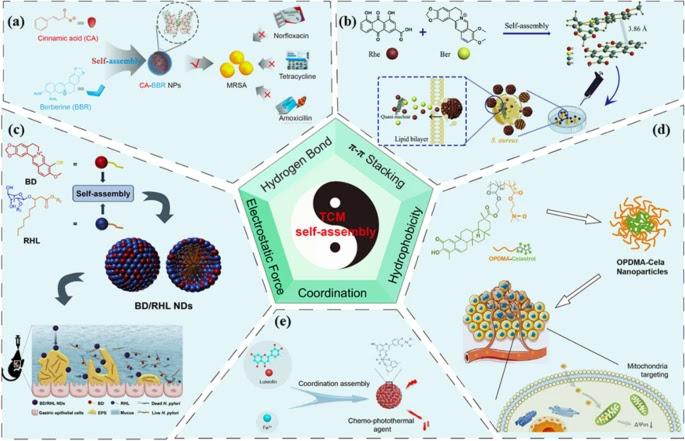
Nicolas Culpeper writes of ground ivy, english ivy, Hedera helix, in his 1550 english herbal, “Government and virtues. It is an herb of Venus, and therefore cures the diseases she causes by sympathy, and those of Mars by antipathy; you may usually find it all the year long except the year be extremely frosty: it is quick, sharp, and bitter in taste, and is thereby found to be hot and dry; a singular herb for all inward wounds, exulcerated lungs, or other parts, either by itself, or boiled with other the like herbs; and being drank, in a short time it easeth all griping pains, windy and choleric humours in the stomach, spleen or belly; helps the yellow jaundice, by opening the stoppings of the gall and liver, and melancholy, by opening the stoppings of the spleen; expelleth venom or poison, and also the plague; it provokes urine and women's courses; the decoction of it in wine drank for some time together, procures ease to them that are troubled with the sciatica, or hip-gout: as also the gout in hands, knees or feet; if you put to the decoction some honey and a little burnt alum, it is excellently good to gargle any sore mouth or throat, and to wash the sores and ulcers in the privy parts of man or woman; it speedily helpeth green wounds, being bruised and bound thereto. The juice of it boiled with a little honey and verdigrease, doth wonderfully cleanse fistulas, ulcers, and stayeth the spreading or eating of cancers and ulcers; it helpeth the itch, scabs, wheals, and other breakings out in any part of the body. The juice of celandine, field-daisies, and ground-ivy clarified, and a little fine sugar dissolved therein, and dropped into the eyes, is a sovereign remedy for all pains, redness, and watering of them; as also for the pin and web, skins and films growing over the sight; it helpeth beasts as well as men. The juice dropped into the ears, doth wonderfully help the noise and singing of them, and helpeth the hearing which is decayed. It is good to tun up with new drink, for it will clarify it in a night, that it will be the fitter to be drank the next morning; or if any drink be thick with removing, or any other accident, it will do the like in a few hours.” (Nicolas Culpeper 1550 from Culpeper’s Complete Herbal)
"Heaven's mandate is heavy; first test its essence and energy, exhaust its will, muscles, and bones; then replenish its deficiencies." — Mencius. You must find a way to overcome difficulties to experience the bright world called the "Way of the Wild Grass." The power driving the body originates from its center. The hips drive the shoulders, the hands connect to the feet, and the elbows connect to the knees. Though the sun and moon are beyond the heavens, they are within us; the sun's radiance shines, and the moon's coolness nourishes us like the hidden fluid in the kidneys. Whoever we are, we must purify and cultivate ourselves daily; young and old alike should participate. Sarcasm, ridicule, jealousy, and suspicion only bring negative results. When we climb to a higher position by stepping on others, we should be prepared to fall. It's best to find a low point in the flow and prepare quietly. Water, though gentle, possesses immense power when it gathers, enough to carve the deepest canyons into the hardest rock. Noise will only make you the first to fall. The lush vitality and melodious birdsong of spring begin with the falling autumn leaves, when the earth's energy flows downwards, and we begin to collect the roots and stems of medicinal plants. Some say that nature's wisdom lies in its own existence; it reveals itself as it is, self-replicates, and constantly renews itself. This is part of the primordial pattern, a gift from nature, and a way to understand nature.

Every day, every week, every month, the clock known as "Ursa Major" keeps ticking. Ursa Major completes one revolution every 24 hours, and another every year. Therefore, we share the same mechanism: a daily 24-hour clock and an annual clock. As humans, we must respect both clocks. In the dark night sky, seven stars form the Big Dipper, part of Ursa Major. Its central pivot, Polaris, is the carrier of the purple celestial pool, from which the celestial atmosphere rises and falls, like the earth's energy, driving the rotation of the celestial wheel. Thus, men and women unite, procreate, offspring multiply into families, families into clans, and clans into nations, thus forming the celestial concept of marriage. By observing the changing patterns of people, plants, terrain, mountains, deserts, and grasslands, we learn to understand the laws governing life's operation amidst change. Life force flows within the body to adapt to change, enhancing physical resilience by acquiring and storing life energy. If we consider breathing as a crucial archetypal complex in the body's respiration process, then no matter how we view breathing, we cannot defy the laws of inhalation and exhalation; otherwise, we cannot survive. We inhale and exhale. What would happen if, like a spoiled two-year-old, we held our breath in a fit of ego, rebelling against our parents' authority? Perhaps we would hold our breath for a moment, our faces flushed, fainting or dizzy, before resuming breathing. Because from any perspective, breathing is essential for survival. The same life force flows in the grasslands in spring, in the mountains in spring, and also within our bodies. When people see signs of spring in the mountains and grasslands, it's because this process began deep within the earth as early as Christmas. That's why people make New Year's wishes in the cold winter of late December. At night, we rest and sleep, not spending 24 hours a day buying and selling under the lights, as this only breeds addiction, and crime often occurs at night. Men and women lose their partners in these nighttime adventures. Demons and hungry ghosts roam the night, so we respect day and night and don't abuse the day-night cycle to harm others. Stars and constellations trace the ecliptic across the night sky, from horizon to horizon, like words written in the night sky. When we wake in the morning, plants and animals are following the guidance of the night sky. We are asleep, so we cannot see the stars in the morning sky, but they do exist, as written in the heavens and on the ground. Modern life resists following the natural cycle of day and night, which puts stress on organ systems and causes illness. Thus, in the fossil fuel-lit modern urban landscape, time seems to repeat the summer solstice 365 days a year, 24 hours a day. It's like every day is July 4th, in modern festival terms. The small body cannot bear this willful, double-burning candle, day after day, year after year, from late June to the winter solstice. The will of the stars will ultimately be enforced as law. When you see the scarlet lorikeet, the western cardinal, and the robin return, you can see the visible plan and take the appropriate action at the appropriate time. The book of stars varies from place to place. People carry books with them, but many of these books should be open notebooks, not finished books. The stars continue to write daily. Therefore, clinging to the same unchanging book, a book not written according to time and place, and repeatedly reading it, is like binding oneself to a book that cannot be hung in a constantly changing world. We, too, are changing systems. We adapt to a constantly changing environment through change. By attentively observing the natural processes of change within our small bodies and the larger whole to which we belong, we can see the vital life force. As above, so it is; as within, so it is. The seasons change, unfolding according to their inherent laws. The symbol of spring is the first bloom of the cruciferous cattail. The blooming, vibrant red and juicy poplar buds and tender new leaves are also symbols of spring, worthy of remembrance, cherishing, and gratitude. Leaves, flowers, and buds—all three symbolize the process of the revival of all things. "The wise use symbols to perceive the spiritual power of all things in the world. Symbols determine form and appearance, connecting all things." (I Ching, Great Treatise) We can use the symbols of the wise, see with the eyes of the wise, feel with the heart of the wise, and listen with the ears of the wise, thus truly seeing the world like the wise. Different circumstances correspond to different herbs and trees. The remedies for nourishing the spirit of life are also diverse. The wisdom of wild herbs is hidden in people, plants, places, mountains, rivers, and grasslands. Since ancient times, people, plants, places, and grasslands have been intertwined. Wherever and whenever, this fusion gives rise to a wisdom known as the "Way of Wild Herbs," an inherent self within life, capable of self-regulation and renewal. Whether in poplar forests, oak forests, pine forests, deciduous broadleaf forests, or on thorny plains, among mesquite, palovant, gobelnardorah, button shrubs, and poplars, this vital self, this self-replicating wisdom, is always present and will always be present. Whether known or not, with sincerity and need, prayer and acceptance will occur. In learning the Way of Wild Herbs in specific places and situations, you must cultivate a life force called "qi." Most people cannot live in a place of mere lip service. We live in a specific place. To hear the beauty of sound, like listening to music, lies in the silence between tones. The way to appreciate the beauty of color in a painting lies in the blank space of the canvas. Otherwise, there will only be noisy sounds and chaotic colors. This is why clamor in music can become political, and flamboyance in color can become ugliness. Both can tire us, limit bodily functions, and ultimately lead to internal organ diseases. Therefore, we should not search for the perfect form in distant places, because the perfect form is the practical form. The perfect form becomes perfect because of its practicality for the user. What is before our eyes is often the most beneficial. There is a misconception that you should cultivate Asian or Chinese "qi," but this is far from the truth. The "qi" you should pursue is the resilience of your life spirit. Similarly, the place you are in right now is your promised land of miracles. You can't find the ring you dropped in the kitchen sink by going to China, just as you can't find the ring you dropped in the kitchen sink by going to China. You must stop immediately and search the kitchen sink quickly and carefully to prevent the ring from being washed down the drain. Whatever steps you take, you must do them, each step forward. The size of your stride determines your pace. The place where your feet land is just as important as your pace. Sages use symbols to observe; you too must see the spiritual forces in the world around you. If the conditions are right, the symbols used by sages may allow you to see more clearly and establish connections, but the most important thing is never the symbols used by sages. Most importantly, it is your connection with them. If a situation prevents you from seeing the world before you, it will inevitably lead to illness, because our lives are our own, and the vitality needed to sustain our lives must come from our own people; otherwise, it will degenerate into exploitation and enslavement. You cannot find the ring you dropped in the kitchen sink by going to China. You cannot find the ring you dropped in the sink by going to China. You must stop immediately and search the sink quickly and carefully to prevent the ring from being washed away. Whatever steps you take, you must do them, each step forward. The size of your stride determines your step. Where your foot lands is as important as your stride. Saints use symbols to observe; you too must observe the spiritual forces of the world around you. If conditions are right, the symbols used by saints might help you see more clearly and establish a connection, but the most important thing is never the symbols used by saints. The most important thing is your connection with these symbols. If a person cannot see what is before them, they will inevitably fall ill, because our lives are our own lives, and the vitality needed to sustain our lives must come from our own people; otherwise, exploitation and enslavement will occur. You cannot find the ring you dropped in the kitchen sink by going to China. You cannot find the ring you dropped in the sink by going to China. You must stop immediately and search the sink quickly and carefully to prevent the ring from being washed away. Whatever steps you take, you must do them, each step forward. The size of your stride determines your step. The place where your foot lands is as important as your stride. Saints use symbols to observe, and you too must observe the spiritual forces of the world around you. If conditions are right, the symbols used by saints may allow you to see more clearly and establish connections, but the most important thing is never the symbols themselves. The most important thing is your connection with these symbols. If a person cannot see what is before them, they will inevitably fall ill, because our lives are our own lives, and the vitality needed to sustain our lives must come from our own people; otherwise, exploitation and enslavement will occur.

Whenever Westerners hear tales of the wondrous Orient, China, and Asia, an unrealistic fantasy inevitably arises within their belief system. This is because sooner or later, the question will inevitably arise: if Chinese and Asian wisdom truly surpasses our own intellectual traditions, then why do these seemingly contradictory events occur? I don't want to bring up human rights issues, or even the pandemic caused by the fish market biological laboratory, because these are difficult to judge. You can consult relevant historical records. Let's look at mercury, this intriguing heavy metal that accumulates in the tissues of all living organisms, including amphibians, reptiles, birds, mammals, fish, and humans. It offers virtually no benefit to the human body. Although mercury has been used as a life-saving antibacterial agent or antibiotic in both the East and the West, its antibacterial properties are too strong and harmful to life, offering no health benefits whatsoever and thus proving useless. It is precisely because of its unusually high density that it accumulates in the body. Mercury accumulates in the body because biological systems have never been exposed to it and therefore have not developed any systematic mercury removal mechanisms. For example, the human body utilizes various metals during metabolism. These metals are utilized because they are exposed to and absorbed during biological processes. For instance, iron in hemoglobin is used for oxygen absorption; hormonal systems such as the pancreas and liver use chromium to regulate blood sugar levels inside and outside cells and to store energy; sodium is used for water transport across cell membranes. Plants utilize these metals in a similar way; we call them minerals because they exist in soluble forms in the soil and are absorbed by plant roots. The roots transport these substances to the leaves and stems. We eat plants and have therefore developed largely the same utilization, a method prevalent throughout the entire life cycle of bacteria, fungi, and plant-animal symbionts. In a sense, we are symbiotic beings of plants and humans. To my knowledge, there is no similar way of utilizing mercury in biological processes. Each exposure to mercury results in a gradual accumulation of its concentration, much like a frog in gradually warming water. Initially, the frog does not perceive the change as the water temperature rises. However, if you put a live frog into boiling water, it will instinctively leap out of the water with its strong legs to escape danger. Mercury, like chemotherapy and radiation therapy in the 18th and 19th centuries, poses a serious threat to cancer patients. The continuous accumulation of mercury in the body reduces life potential, weakens vitality, leads to decreased cognitive abilities and damage to the nervous system, and this damage is often irreversible. As a toxic heavy metal, mercury can be fatal.
So why is the frequency of mercury presence increasing in biomes that have never been contaminated before? The reason is that mercury is being brought to the surface from deep underground. Mercury is being extracted and dispersed. For example, gold has been highly valued throughout human history. Ancient gold, similar to fossil gold, is often called placer gold, or free gold. It's called free gold because it exists in the form of gold nuggets and tiny gold grains. Free gold is so named because it is not bound to other substances. It is exposed in sand and sediment washed by flowing water, from exposed mountain deposits. Placer gold, or free gold, is essentially a very stable element that hardly undergoes any chemical reactions. As the population grows, the demand for gold increases. These stable, non-chemically reactive placer gold deposits are primarily mined using gravity. Gold, as a non-toxic heavy metal, separates and sinks to the bottom of water due to its density and weight. Therefore, people began panning for gold in streams. As these easily mined gold resources gradually depleted, other methods of separating gold from low-density ore deposits became ineffective. Techniques for crushing low-density ore and soaking the crushed rock in mercury settling ponds expanded to large-scale industrial production. Gold smelting technology also expanded to open-pit mines visible from satellites. In the western United States, much of Nevada is a vast low-density gold deposit. These enormous mercury-bearing sedimentation pools are scattered throughout Nevada. Similarly, as exploration for copper and other minerals expanded to open-pit mines stretching for miles, minerals such as silver, platinum, gold, and mercury were discovered in the rubble of these mines. So much so that in most open-pit copper mines, the highest economic value of the ore body comes from the associated gold. Gold is valued at $2,000 per ounce, while copper is valued at only $0.23 per ounce—a gold-to-copper value ratio of 8700:1. These underground mercury deposits are constantly being unearthed during metal smelting and float in the air like dead pollen, spreading with the wind.
Let's return to our earlier casual interpretation of Chinese wisdom, and its deep-rooted respect for the Tao, nature, and even toxic mercury. How does one fall in love with this dazzling array of Asian wisdom, with the Tao, the Buddha, and Eastern wisdom, and become caught in a sweet honeymoon of blind worship of everything Asian and everything the Tao is? Falling in love with this amazing system of wisdom, only to find that those born and raised there, immersed in its traditions, are leaving it? Like frogs slowly being boiled in water, they are leaving the traditions rooted in Asian nature. Within this honeymoon lies a profound observation, like a question: If China is so superior, why do we see so many people of Chinese descent choosing to leave China and settle in places like Buffalo, New York? Or will the tens of thousands of Hindus from the Indian subcontinent choose to abandon everything in Asia and India and head to Pittsburgh, Pennsylvania? The answer is complex. Returning to the topic of mercury, China has chosen coal-fired power generation, burning mined coal. The scale of coal mining and combustion is so massive that the air drifting over the Pacific Ocean deposits mercury from the coal in Canada, British Columbia, and along the Pacific coast of the United States, forming mercury-laden acid rain. This mercury is absorbed by plant roots, consumed by livestock such as cattle and sheep, and ultimately enters grains, milk, and meat. Therefore, the amount of mercury from mining, metal smelting, and the combustion of gasoline in internal combustion engines, as well as the mercury content in the human body, increases and accumulates year by year. As people age, their cognitive abilities gradually decline. Alzheimer's disease, the cognitive decline that occurs with age, is in most cases a result of mercury exposure and the toxic effects of low-concentration mixtures of various harmful chemicals. One of the biggest reasons Asians leave their home countries is environmental pollution, poverty, and a decline in living standards due to over-industrialization and overcrowded living environments—not out of love for nature, but rather a profound cultural adaptation failure.

He stood beneath the poplars, strolling among the Fremontese poplars (Populus fremontii), trees with heart-shaped leaves. He sat on the sun-bleached, grayish-white, ravine-strewn hollow branches. In such a place, he could comprehend the eight forms of the previous illustrations. As he faced east, meeting the rising sun, he understood that to the right was the sky, or south; to the left, the earth, or north. Above was the sky, with the sun, the moon, the blue sky, and the light—this was the sky, the sky, the sky, a flame in the palm of his hand. When the sun reigned supreme, the sky was warm, bright, and radiant. Below was the damp earth. The damp earth was cold and dark. Roots dug deep into the ground—this was the earth as he understood it. In the cold, damp underground, roots grow. On the warm, dry ground, leaves and branches grow. Thus, he understood the southern sky above and the northern earth below, like two points on a compass. The compass is a rotating disc, though the shape of the compass on our paper is merely a symbol, a memory of this rotation. Hands and feet are like roots, leaves, and branches. Today we walk on two legs, later on two feet, yet our feet contain the shape of hands, and our hands contain the shape of feet. Also understand that hands are omnipotent; they can do many things. Sometimes hands build, sometimes hands destroy what has been built. They are the same hands. The hands are connected to the Laogong acupoints on the palms, like leaves and branches, and are associated with the fire element of the east, symbolizing the rising sun. The soles of the feet are connected to the earth, like roots, and are associated with the spring in the north, symbolizing the nourishing water of the west.
The operation of the wheel originates from the eight elements in the early model: heaven, wind, wood, flowing water, mountain, earth, thunder, fire, still water/swamp/lake, ultimately returning to heaven. As the sun sets, the sky cools and darkens. People can see the poplar leaves trembling and swaying in the breeze. This stirring is the wind, which connects and permeates all things. The wind blows the clouds, bringing babbling brooks. When rain falls on the mountains, the rushing rain makes a babbling sound. This rushing rain pours down from the mountains. Underground, roots penetrate deeply into the soil; this is the earth. Understanding the changing seasons, in early spring, thunder and lightning awaken the earth's energy, and heaven and earth merge. They have round drums, their drumheads taut like rings. In the fusion of heaven and earth, there is a stirring and a merging. The wind brings clouds, and the clouds bring thunder and lightning. So they light fires for warmth. Rain falls, and the rushing torrents make a murmuring sound. These torrents rush down from the mountains, gathering in low-lying areas to form swamps and lakes. The water accumulated in the low-lying areas rises into the clouds like mist, forming a cycle, ultimately returning to heaven and earth. Heaven, wind, wood, water, mountain, earth, thunder, fire, accumulated water, swamps, and lakes, return to heaven and earth in sequence. The drumheads can see and remember where the sun rises and sets. From four directions, each direction forms eight directions.
In Chapter 3 of the ancient Chinese classic *Tao Te Ching*, we read, "Empty the mind, fill the belly." So, what exactly do "empty" and "fill" mean? And to whom are these emptiness and fullness addressed? The author is Lao Tzu, a Daoist philosopher. Lao Tzu is one of the core cultural heritages of China, a country we now call a "bioregional nation." Lao Tzu is the founder of Daoism. Like most ancient books that have survived from that time, these discourses are concise and broad in meaning, and can vary depending on the speaker and the recipient. The oldest extant version of the *Tao Te Ching* dates back to the 2nd century BC, written on bamboo slips. We know that Lao Tzu's exact birthday was the 15th day of the second lunar month, 2595 years ago. This year, his birthday is March 24, 2024, the Year of the Rabbit in the lunar calendar, also known as the Green Tiger year, close to the spring equinox. He left the Daoist texts to the gatekeeper of Hanggu Pass near the Yellow River. This sage is believed to be Lao Tzu, an ancient Chinese official belonging to the tradition of virtuous rulers, who famously said, "Empty your mind and fill your belly." The problem is that this sage Lao Tzu was offering advice to the ruling elite 2,500 years ago (who today might be elected officials, CEOs, or influential political leaders), who in turn were advising ordinary people to remain relatively silent while guaranteeing them food and clothing. Many translations express this view to varying degrees. Of course, ensuring the people of a city-state are well-fed and clothed, maintaining a peaceful and efficient social environment, and ultimately benefiting all, does indeed contain truth. Famine, food shortages, and political intrigue—regardless of political system, are never good things for those in power or the lower classes. People need to be fed and clothed. Hunger, prejudice, and fear prevent people from having a good life, regardless of social class. Revolution, while celebrated in the world of adventure dramas, is not a good omen for life expectancy and a prosperous, stable, and meaningful daily life. Does the concept in the Tao Te Ching refer to how to organize and manage large or small groups, such as businesses or families? What does clearing one's mind truly mean? What do emptiness and fullness mean? Is this sage telling us to eat a hamburger, drink a beer, and relax? Or is it telling us to nourish our bodies with a salad of vegetables, nuts, and berries? Who exactly is this wise sage? Is this sage the "wild grass way of genius"? Is it an almost metaphorical explanation of the real biological realm of plants, people, places, and grasslands? Is this "wild grass way of genius" talking about the abdomen? Stomach, food, eating, emptying? Body breathing, life spirit? Then, what does all of this mean? And what does it mean to communicate with concise, often rhyming, poetic riddles? The answer is that Lao Tzu admonishes people to "empty the mind and fill it," the meaning of which encompasses all of the above. Like almost all existing ancient Asian texts, the *Tao Te Ching* possesses a high degree of subtlety and abstraction. It offers advice and insights to rulers, leaders, group managers, and anyone attempting to understand a predicament, as well as guidance on the actual abdomen and the mythical, poetic deeper levels of the abdomen such as the dantian, solar plexus, or dantian. Lao Tzu's writings are part of a revelatory tradition from the world of meaning.

A meaningful world is, of course, a world full of meaning. The biggest problem is that meaning requires smooth connections. We can say that meaning needs meaning, and meaning needs connections. Conversely, we can also say that meaninglessness means that humanity lacks a sense of connection. Meaning and connection are related. The more connections, the richer the meaning; the fewer connections, the less meaning. The connection of meaning means a large number of associations pointing to other things. By pointing to other things, we acknowledge that what we are pointing to is connected to ourselves. Children play dominoes, connecting the numbers on one side of the dominoes according to established rules to form a continuous pattern. Children also play games based on the physical shape of dominoes. They stand the dominoes upright, arranged closely together, so that when one domino is pushed over, all the dominoes begin to fall, making a clattering sound. The world of meaning includes games like regular number dominoes and the clattering game of toppling dominoes. In both cases, we use the same dominoes, but our understanding of them is drastically different. It's not that dominoes themselves have changed from numbered dominoes to point-and-click dominoes, but rather that our perspective has shifted. Meaning exists in connection. When we live in a world full of meaning, everything has meaning. Our pointing actions acknowledge our connections in time and space. By pointing, we acknowledge our connection in meaning, acknowledging our existence as "us." Because everything is connected, this connection isn't based on any particular theory of connection, but is a genuine link. If you ask a child, "Who is your mother?", the child will point to her mother and nod, indicating "her." This act of pointing contains a connection spanning six years. A mother is sometimes a mother who cooks, sometimes a chef who prepares nutritious meals; sometimes a counselor who listens attentively; sometimes a breastfeeding mother with her breasts full of milk; sometimes a storyteller; sometimes a laundry maid; sometimes a mother who picks up and drops off her children. She is a mother who bakes bread, a mother who ties shoelaces. She is the embodiment of motherhood in many ways. All these different images of motherhood are contained in a single, simple action. The Buddha held up a flower to Mahakasyapa. Although he was only making a hand gesture of holding the flower, his act of holding the flower also symbolized the transmission of teachings directly between people, transcending boundaries, and the treasure trove of the true eye of Buddhism.
The tree-shaped rotating diagram opens the four gates of Qigong.
Here, we find the four main gates of the human body on the flesh of the hands and feet. This is called the Opening of the Four Gates Qigong. It has been described many times in various ways: " The palms connect to the Laogong acupoint in the center of the palm, like leaves and branches, connecting eastward to the fire of the rising sun; the soles of the feet connect to the heels, like roots, connecting northward to the Yongquan acupoint in the sole of the foot, and westward to the nourishing water. Therefore, the hands and feet are tools for learning, used to guide and control energy, directing the large external energy field to the small internal energy field. This is a way of connecting. The connection between these two energy fields itself contains meaning, because we use various symbols to point to it, not just to the things themselves. The Laodong acupoint on the palm is..." The center of our innermost thoughts and deepest intentions is the place where everything we do is accumulated through the labor of our hands. Therefore, in this sense, taking responsibility for everything we have and everything we are experiencing is our work. Blaming others for misfortune is a fundamental mistake that must be corrected. This is the meaning of the Lao Dong acupoint; it is the center of our work. Starting from the Lao Dong acupoint on the palm, by moving both hands and opening and closing the fingers, we can see the wrist, forearm, and upper arm flowing like streams and rivers—the flow of the cosmic life energy "Qi".
The Yongquan acupoint is located on the sole of the foot, between the second and third toes, in front of the arch, at the center of the foot. The foot is an organ often overlooked or specialized in the human body. It has 52 bones, accounting for a quarter of the total skeleton. This is called "Yongquan." Yongquan is a spring of living water, circulating upwards like kidney qi; it belongs to Yin, and is cool and dark in nature. We can draw living water from our hands and feet. It is well known that foot binding, although considered a custom for keeping concubines, was actually harmful to the body. This custom of foot binding for keeping concubines is not an ancient tradition in China. Foot binding harmed women in the past, and it continues to harm them in other ways today, such as wearing excessively high heels, using strange paints to cover their faces, and soaking their scalps in corrosive dyes—all of which should be avoided. Exquisite high heels will disrupt the flow of vital spring water.
Activate the four gates of Qigong. We coordinate our hands, feet, hips, shoulders, elbows, and knees. Pull both hands inward, rotating the palms as if pulling a rope. We focus on the space between our hands, which is called gripping the ball, rotating the ball, spinning the ball, squeezing the ball, spinning the ball, lifting the ball, lowering the ball, etc.
The first story my teacher told was that we are one day closer to death every day. He would say, "Today you are one day closer to death." He always said this with a smile, and everyone would laugh. He also told a story about people being chased. This story was recorded by the 19th-century Russian writer Leo Tolstoy: " An ancient fable circulates in the East, telling of a traveler who is attacked by a ferocious beast on the steppe. To escape the beast, the traveler hides in an empty well, only to find a giant dragon at the bottom with its blood-red mouth wide open, about to devour him. However, he still clings tightly to a branch, looking around, and sees two mice, one black and one white, gnawing around the bush from which he hangs. Sooner or later they will break the branch, and he will fall into the dragon's blood-red mouth. The traveler witnesses all this and knows that he is doomed. But he still hangs there, and sees on the leaves of the bush..." A few drops of honey, and I licked them with my tongue. I was the same, clinging tightly to the tree of life, knowing the dragon of death awaited me, ready to tear me to pieces, yet unable to understand why I had fallen into such torment. I tried licking the honey that had once comforted me, but it no longer brought me any joy. White and black rats—day and night—gnawed at the branches I hung from. I could clearly see the dragon, and the honey was no longer sweet. My eyes were fixed on only one thing: the inescapable dragon and the rats; I couldn't take my eyes off them. This is not a fable, but a fact, an undeniable fact that everyone can understand.
What once suppressed my fear of dragons has now rendered my allure of life's pleasures ineffective. No matter how many times others advise me—"You can't understand the meaning of life, don't think about it, just live well"—I can't do it, because I've lived too long. Now, all I see is the relentless pursuit of death, leading me day and night. This is all I can see, because it is the only truth. Everything else is a lie.
Those two drops of honey, more than anything else, helped me ignore the cruel truth: my love for my family and writing (which I call art) no longer felt sweet.
—Leo Tolstoy, *Confessions and Other Religious Writings*

Sextet
When practicing Qigong routines, remember the Six Harmonies. This ensures a good standing posture and smooth energy flow, making the movements fluid and continuous.
External Harmony
1) Coordination between hands and feet
2) The hips and shoulders are coordinated.
3) Elbows and knees are coordinated.
Internal harmony
1) Harmony and unity of mind and intention
2) Coordination of intention and breath
3) Coordination between breath and movement
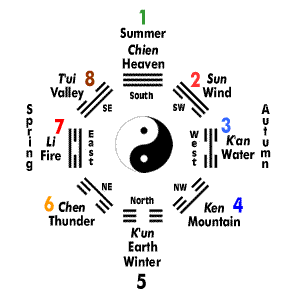
Baguazhang? Also known as Pa Kua Chang or Bagwa Jang Baguazhang Qigong.
The world is ever-changing and impermanent. Those who embrace and adapt to change will succeed; those who resist and cannot adapt will be eliminated. Adapting to change is following the vitality of life and the way of life; failing to adapt to change is going against the vitality of life and the way of life. According to the Tao Te Ching, going against the way of life is death.
One important concept taught in the *I Ching* is that everything has a center. The center of the solar system is the sun, around which everything revolves. The Earth has its central axis, around which it rotates day after day. The center of a hurricane is its eye, around which everything revolves. Our bodies are a microcosm of the natural universe. The spine can be considered a center around which the body rotates. The dantian (lower abdomen) is also a center. There are other centers within the human body, such as the shoulders, elbows, knees, wrists, ankles, and neck. You can rotate different parts of your body around these centers. This is the principle behind Baguazhang (Eight Trigrams Palm).
Baguazhang Principles
Spring, Summer, Late Summer, Autumn, Winter
Wood, Fire, Earth, Metal, Water
Yin, Liver, Heart, Spleen, Lung, Kidney
Yang's bile, small intestine, stomach, large intestine, bladder
Anger, hatred, blame, trust, sarcasm, arrogance
"Don't blame others" is like a boomerang; it will eventually bounce back and hit us. I used to blame others like that. Negative emotions—blame, hatred, anger, sarcasm—are stored in our bones and organs. Thoughts, mind, and spirit govern everything, forming a hierarchy. Love releases energy in the body.
Five-element relationship
Written by Wan Minying, 14th Century 1
Translated by Heiner Fruehauf , Institute of Classical Traditional Medicine, National University of Natural Medicine, France
"Metal generates earth, but too much earth buries the metal; earth generates fire, but too much fire scorches the earth; fire generates wood, but too much wood intensifies the fire; wood generates water, but too much water washes away the wood; water generates metal, but too much metal makes the water turbid."
Metal generates water; too much water will drown the metal. Water generates wood; too much wood will deplete the water. Wood generates fire; too much fire will burn the wood. Fire generates earth; too much earth will bury the fire. Earth generates metal; too much metal will cause the earth to rot.
Metal overcomes Wood; however, if the wood is hard, even metal will be damaged. Wood overcomes Earth; however, if the earth is thick, even wood will break. Earth overcomes Water; however, if there is too much water, earth will erode it. Water overcomes Fire; however, if the fire is intense, water will hiss and crack. Fire overcomes Metal; however, if there is too much metal, fire will be extinguished.
Weak metal melts when it encounters fire; weak fire is extinguished when it encounters water; weak water is filled and stagnated when it encounters earth; weak earth collapses when it encounters wood; weak wood is split when it encounters metal.
When metal is excessive and encounters water, its sharpness is dulled; when water is excessive and encounters wood, its kinetic energy is weakened; when wood is excessive and encounters fire, its density changes; when fire is excessive and encounters earth, its intensity is suppressed; when earth is excessive and encounters metal, its potential for disaster is limited. © 2007 Heiner Fruehauf
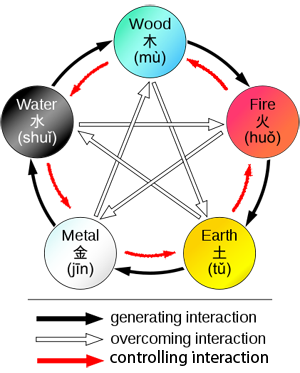
Constructive cycle:
Wood aids combustion
Fire creates the earth
Earth created metal
Metal enriched water
aquatic wood
If this cycle is reversed, each element will be reduced or destroyed by another element:
Destructive cycle:
Fire will burn the wood.
Wood consumes water
Water corrodes (rusts) metals.
Metals consume the Earth
Earth swallows flames
If we look at this cycle from another perspective, we will find that the various elements are mutually controlling:
Control cycle
Fire-resistant (or molten) metal
Metal Control Wood
Wood controls the earth
Earth controls water
Water control fire
These interrelationships are the cornerstone of Traditional Chinese Medicine. The functioning of any system or organ influences other systems or organs. When one organ is out of balance, it affects all other organs. This balance can be determined through the concepts of heat, cold, dampness, dryness, yin, and yang. Emotions, diet, environment, and genetic factors all affect organ function.
Based on the Five Elements theory, each element generates different energies or frequencies within the body. During pregnancy, these energies guide the formation of the fetal organs and are supported by the mother's energy channels. When the new soul enters the body, these qualities also form spiritual attributes, which are protected by the five Yin (physical) organs. The relationship between the organs and emotions forms the basis of the holistic integration of mind, body, and spirit in Traditional Chinese Medicine. The emotional/spiritual attributes of the Five Elements include:
Fire—Order—Heart
Earth—Trust—Spleen and Liver
Metal—Integrity—Lung
Water—Wisdom—Kidney
Wood—Compassion—Liver
After birth, these pure qualities must be cultivated to manifest in a person, because in life we inevitably encounter various difficulties, traumas, and hardships, which can cause other energies or frequencies to manifest in our bodies as harmful emotions and thoughts. It is believed that these harmful emotions and thoughts accumulate in various organs. These intense emotions can lead to stagnation of qi, which in turn can cause illness.
In Traditional Chinese Medicine (TCM) theory, Qi, or life energy, drives the movement of bodily fluids (blood, lymph, and metabolic waste). Therefore, when Qi stagnates, the movement of bodily fluids is obstructed. Consequently, the functions of the internal organs weaken.
Each organ contains different emotions. These emotions have different frequencies and different effects on Qi (vital energy).
Fire—Heart—Anxiety, Extreme Joy
Earth—Spleen—Worry, distrust, obsession
Metal—Lung—Grief, sorrow, shame, regret
Water—Kidneys—Fear, Loneliness
Wood—Liver—Anger, Fury, Resentment
Wood—(Yin) Liver—(Yang) Gallbladder
Fire—(Yin) Heart—(Yang) Small Intestine
Earth—(Yin) Spleen—(Yang) Stomach
Metal - (Yin) Lung - (Yang) Large Intestine
Water – (Yin) Kidney – (Yang) Bladder
- Spring/Wood belongs to (Yin) Liver and (Yang) Gallbladder.
- Summer/Fire belongs to the (Yin) Heart and (Yang) Small Intestine, and also to the (Yin) Pericardium and (Yang) Triple Burner.
- Late summer/Earth sign corresponds to the (Yin) spleen and (Yang) stomach.
- Autumn/Metal corresponds to (Yin) Lung and (Yang) Large Intestine.
- Winter/Water represents the (yin) kidneys and (yang) bladder.
While the West believes there are four seasons in a year, Taoism believes there are five. The order of seasons that Westerners are familiar with is spring, summer, autumn, and winter; however, Taoism considers late summer (sometimes called "Little Spring") to be an independent and unique season, a time of balance and harmony.
Five Elements Theory
The Five Elements—Earth, Fire, Water, Metal, and Wood—are a theory used by ancient sages to describe patterns and relationships among many variables. They are interconnected in an abstract sense and can be used to explain the relationship between the changing seasons and various aspects of our lives, as well as the human body. The Five Elements theory is one of the main philosophical systems of traditional Chinese medicine and is applied in acupuncture treatment. Furthermore, the Five Elements theory is also used as a guide for balancing physical and mental health. Based on the Taoist theory that "humans are a microcosm of the universe," the human body also experiences cyclical patterns similar to those in nature, such as the seasonal changes and the cycle of life and death in Baguazhang (Eight Trigrams Palm).
The *I Ching* is considered an ancient classic. Its oldest part was a single-page diagram, which, through centuries of refinement and supplementation, has become rich and clearly structured. As a foundational work with reflective significance, the *I Ching* describes various patterns of change observed by specific groups within a particular biological region. It records people's perception of their own ecosystem, and in this sense, it predates the culture of Asian biopsychology and later medical applications. Therefore, the *I Ching* elucidates the "Tao," the "non-action" of the unified, which is divided into Yin and Yang, with the vital force "Qi" operating in a flowing, cyclical pattern of change through visible observation. The book describes the Eight Trigrams, divided into two or three lines: Yin and Yang. The Yin line is dashed, and the Yang line is solid. The Eight Trigrams are determined by three possible x or y combinations, namely (-) and (+). Yin and Yang (-) represent eight numerical, mathematical, and logical possibilities. For example, Yin-Yin-Yin-, Yin-Yin-Yang-, Yin-Yang-Yang, and so on, a total of eight. Each combination is named and associated with symbols representing eight sequences of changes: Heaven/Void, Earth, Thunder, Water, Mountain, Wind, Fire, Lake/Swamp. In terms of herbal medicine, any herb represents the Yin and Yang of the plant, its life spirit. Plants contain a self and therefore possess a basic self-replicating intelligence, similar to humans. In Traditional Chinese Medicine, plants are used in combination in the form of prescriptions. In the human body, organs are considered one of the five elements. In a healthy body, all organs function efficiently and harmoniously. The two basic forces of Yin and Yang interact within the body, and ideally, these two forces are kept in balance.

Wang Wen's "The Day After Tomorrow" Gossip Remix
Qian (乾) Heaven, Summer, Creative; Father; South, Expansive energy, the sky. Xun (巽) Wind, Summer, Gentle; Eldest Daughter; Southwest, Gentle penetration, flexibility. Kan (坎) Water, Autumn, Abysmal; Middle Son; West, Danger, rapid rivers, the abyss, the moon. Gen (艮) Mountain, Autumn, Still; Youngest Son; Northwest, Stillness, immovability. Kun (坤) Earth, Winter, Receptive; Mother; North, Receptive energy, that which yields. Zhen (震) Thunder, Winter, Arousing; Eldest Son; Northeast, Excitation, revolution, division. Li (離) Fire, Spring, Clinging; Middle Daughter; East, Rapid movement, radiance, the sun. Dui (兌) Lake, Spring, Joyous; Youngest. Daughter Southeast Joy, satisfaction, stagnation. King Wen "Later Heaven"
The Five Elements theory explains the relationships between the various organs of the human body, how energy is transported to each organ through the meridians , and how Qi (energy) originates from the kidneys. The main function of the kidneys is to filter the blood and then transport it to all parts of the body.
Qi is related to the kidneys because the kidneys are believed to contain the opposing energies of fire and water. An imbalance of these two elements can affect other organs. In a healthy body, all organs function in harmony, and all elements are in balance. In an unhealthy body, organ dysfunction occurs, which in turn creates a chain reaction affecting other organs.
When practicing Tai Chi and Qigong, the focus of meditation is on concentrating attention on the abdomen, specifically the Dantian and Mingmen points. The Dantian and Mingmen directly nourish the nearby kidneys. The movements of Tai Chi and Qigong rotate and massage this area, thereby balancing the kidneys and consequently influencing the function of other organs. One of the original design principles of Tai Chi was to nourish and support kidney function.
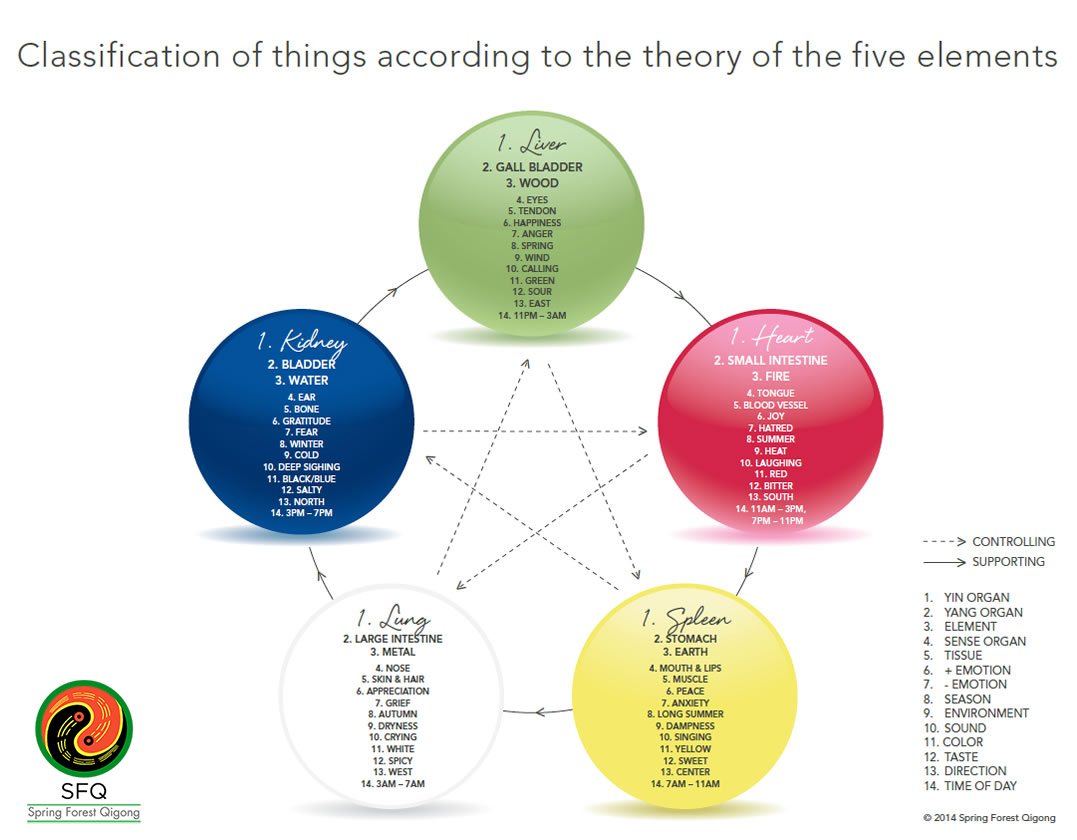
The diagram below ( from *Chunlin Qigong* ) illustrates the relationships between the Five Elements. The outer circle of arrows represents the nourishing or supporting relationship between adjacent elements: Wood nourishes Fire, Fire (or ashes) nourishes Earth, Earth contains Metal, Metal condenses Water, and Water nourishes Wood. The dotted lines represent the cooperative or restrictive relationship between two "opposing" elements: Wood overcomes Earth, Earth overcomes Water, Water extinguishes Fire, Fire overcomes Metal, and Metal overcomes Wood. The diagram also shows the influence of the Five Elements on other aspects of our lives.
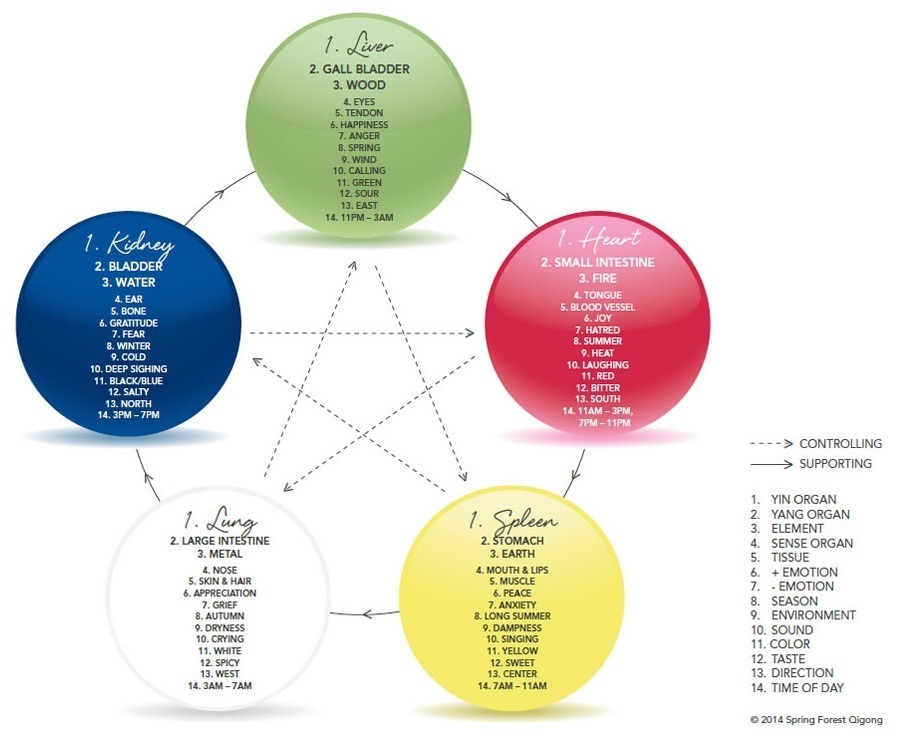
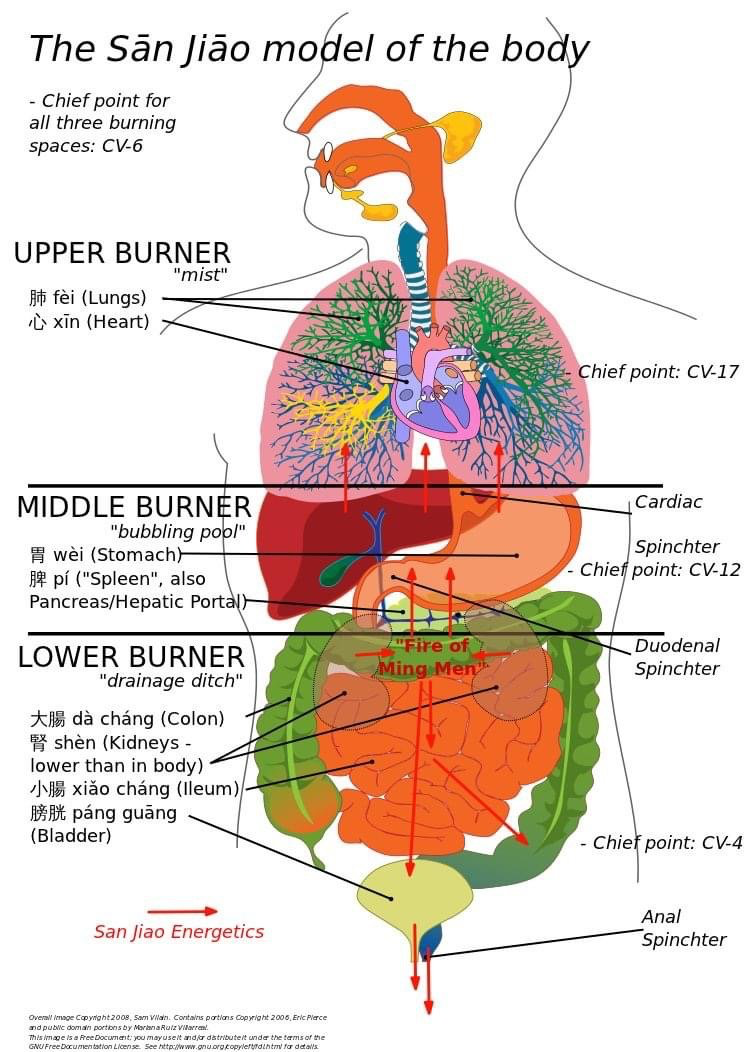
"Kidney water flows backward." The lower dantian is located in the lower abdomen, where our consciousness resides and where qi is generated. The middle dantian is located in the heart. The upper dantian is located in the brain. "Transforming essence (sexual energy) into qi (life energy), and then transforming qi into spirit (spiritual energy)." The first step is to establish a connection with the purplish-red ultraviolet rays of the North Star and the Big Dipper, one of the strongest forms of celestial light. Through this practice, one learns to sense qi and uses the power of intention, eyes, and heart (intention-2) to guide the flow of qi in the body's main energy channels. This is the foundation of Taoist meditation. The order of the organ healing sounds is: lungs, kidneys, liver, heart, spleen, and triple burner. The triple burner (or triple burner, triple burner) is "three burning spaces." The Triple Burner (San Jiao) does not have a completely corresponding anatomical structure, but rather a correspondence. One of the main functions of the Triple Burner is to regulate the movement of water in the body. According to Traditional Chinese Medicine theory, water behaves differently in each of the three burners. The Upper Burner (Shang Jiao) is located above the diaphragm and includes the heart and lungs. Its function is to transport body fluids throughout the body in the form of mist or vapor.
The middle jiao ( middle burner) encompasses the area above the navel and below the diaphragm, including the spleen and stomach. Its main functions are digestion and transporting nutrients throughout the body.
The lower digestive tract , located below the navel, includes the liver, kidneys, large intestine, small intestine, and bladder. It is responsible for separating food from metabolic waste. Beneficial fluids are absorbed, while the remainder is transported to the bladder.
The Triple Burner, functional medicine, intertwined. We, as the microscopic world, are intertwined. Our bodies are integrated with the macroscopic world. All components are interconnected and diminish over time. I am the beginning, I am the end, I am the source. A dragon with a pig's snout is devouring its own tail; this dragon is the pig, extremely prolific, a living garbage can, nurturing new life. Wuwei, the master of pure sound experience, music is Wuwei. From November 1st to December 1st in the Northern Hemisphere, the hexagram is Kun (坤), six yin lines broken. Unite with the source. Feel one with the ocean, becoming a cup, a molecule of water in the ocean. The ocean, immerse yourself in it, become one with the ocean, like the pericardium. The fire rests. The ocean, the source of the ecosystem. The tranquil moment of the year, when energy flows underground, is followed by the winter solstice. The Triple Burner is the tomb. The story of source energy, from 9 PM to 11 PM. The time of the Triple Burner. The function of the Triple Burner is rest and introspection; ideally, one should fall asleep before 9 PM to avoid adrenal fatigue. Rest time is the first half of the night, from 9 PM to midnight, which is the most important cycle of sleep. Unity, complete integration into the flow, a state of non-action. The pure energy of the universe. Yin and Yang not only describe opposing poles but also the process of transformation. Unlike linear processes, the spleen, as a producer of energy, is prone to coldness and dampness. The kidneys are mysterious and unpredictable, dark and obscure. The Triple Burner is the continuum of life force, the ebb and flow of energy underground. Therefore, the darkest months are the true yang months. It is compressed into a seed, a physical point. All the energy is here. The Triple Burner (San Jiao) is the connection between various systems, a network system, a net, an inverted tree, which can be figuratively imagined as roots, the lymphatic system, the nervous system, and the endocrine system. Water does flow, but its flow is not exactly the same as water flowing in pipes. Water exists outside cells, in the spaces between cells. When drilling for water or oil, water does not exist merely as underground lakes or pools, but within seemingly hard rock, which itself contains water. Therefore, a well is a vertical, hollow structure, deep underground, where water passes through seemingly hard rock under immense pressure. A well is like a painting, drawing in oil and water through negative space and then extracting them. Water in the human body also exists in bones and throughout the body, but it is not as pure and transparent as water in a glass. It is more like dampness. There are kidney water, bone water, brain water, lung water, liver water, bile water, etc., but they are not clear, transparent free water. Therefore, the Triple Burner Meridian refers to the complex, interconnected, constantly changing, ebb-and-flowing system within the body. A wheel has twelve spokes, but the hub, the empty part, is what truly performs its function. Go to bed early. Remember, surface activity originates from rest. Similarly, the spine can generate movement even at rest. Power originates from the core of the spine. Leisure time is like a vacation. Let the universe work its magic, rather than acting recklessly out of self-centered ego, which only leads to exhaustion. Therefore, adequate rest is essential for replenishing energy. If a well is constantly drained, it will dry up and require the water table to flow back to replenish the unseen aquifer. Rest is key to action.
https://pgmanski.blogspot.com/2025/12/pauls-tree-sutra-turtle-island.html
The question arises: what is Qigong? Qigong, also spelled "chi-gong" or "chi-gong," pronounced "chee gung," with gentle vowels and consonants. Qigong is the vitality of mutually beneficial friendship, the ultimate experience of friendship, because everything we do is mutually beneficial. We are intimately connected to experience, and when we cease to nourish our fundamental roots, the tree withers. The ideal of altruism degenerates into an unsustainable, pathological altruism. The best way for us to help each other is to nourish our fundamental life spirit, the essence of giving and receiving in the world of life. There is no pushing without pushing; all things are interconnected through mutually beneficial relationships, and this relationship is nourishment. Previously, in pinyin-based Chinese, it was called "ch'i kung," but now it's called "qigong." Etymologically, these two characters are "qi" and "gong." "Qi" or "chi" refers to rice and steam, thus representing nourishment; "steam" represents heat and fire. Rice nourishes the body, just as people grow grains and then cook them with steam. "Qi" (or "qi") is thus extended to mean not only the body but also the life energy of the entire world, broadly referring to the biological realm and more specifically to our human body. The word "gong" (or "gong") originates from a carpenter's ruler and plow. Etymologically, both the ruler and plow are human tools held by hand; "gong" refers to actual labor, that is, creation or achievement. Therefore, these two characters, "qi" (氣), now primarily refer to nourishing life energy, while the square ruler is used to determine the correct angles in architecture, and the plow is used for farming. Both are related to achievement and are essential for survival. Just like kung fu (or "gonggong"), you may have heard of kung fu or seen kung fu action adventure movies starring Bruce Lee. You might be surprised to find that the two words kung fu and qigong—"gong" and "gong" are the same Chinese character—both refer to skills, learning, diligence, achievement, and practice, such as art forms like ballet and painting, obtaining a university or nursing degree, attending prenatal classes to learn how to prepare for childbirth and care for your first baby, or equestrian sports like horseback riding, and have absolutely nothing to do with kicking someone in the head or striking their nose with an elbow. For some reason, in certain circles, breaking someone's nose, learning how to cause traumatic brain injury, and watching them fall to the ground seems more entertaining than attending the International Breastfeeding Association's Lamaze method of childbirth course.
What does Qigong mean? I define "Qi" as the nourishment of life energy, and "Gong" refers to diligent effort, ultimately achieving mutual benefit. Therefore, the core of Qigong lies in nourishing life energy, thereby achieving mutual benefit. This process of nourishing life energy contains some basic positive cognition, that is, prediction. Usually, people regard prediction as a spontaneous, erroneous cognition and evaluate it negatively. However, all learning is based on making assumptions and quick judgments. For example, if you smell smoke, you might think: I'd better go check it out. What is that smell? What's burning? Did I forget to turn off the stove? Where is the smoke coming from? Is it firewood for grilling, or something dangerous? When you see a flame, you immediately recall past experiences: flames are hot. Therefore, quick judgment is a good thing; it demonstrates wisdom. When you buy a new appliance, it comes in a box wrapped in thick plastic film, and inside is a user manual showing you how to assemble, maintain, and so on. Our lives don't have perfect user manuals, even though we are increasingly surrounded by plastic. Some so-called "official user manuals" are also filled with much questionable information.
The first conception about Qigong is that, under current conditions, our lives mean being dependent on the physical body and rooted in the human form. Therefore, most of our work as humans is related to maintaining and nourishing the body. The concept of nourishment is the correct nourishment through mutual benefit. Mutual benefit means nourishing life. Clearly, plants are living organisms, and the metaphor of caring for plants also applies to Qigong, that is, practicing nourishing life. Plants primarily live in the broader external world; for example, there might be a dense pine forest on a mountain. Along a watershed, there are riparian zones where deciduous trees grow. All these plants in the forest are adapted to the ecosystem of their respective bioregions. Humans are born with the instinct to care for and nourish things. People enjoy cherishing beautiful things. In all these nourishing tendencies, there lies a mutually beneficial relationship. Thus, someone might care for and feed chickens. Besides the beauty of chickens and the sight of them playing, we also care for them through disease, hot summers, and cold winters. Chickens eat insects, utilize kitchen waste, and provide fertilizer to improve the soil—all mutually beneficial. Chickens also produce meat and eggs, another form of nutritional reciprocity. Of course, plants, like gardening, provide nutrition and many benefits. We have fruits and vegetables to nourish our bodies. There are also medicinal herbs with healing properties, such as elderberry, mullein, angelica, coneflower, and rosehip. Gardening also provides nutrition. Trees provide shade and shelter from the wind. Flowers are pleasing to the eye and fragrant, creating a mutually beneficial relationship. We can bring plants into our living spaces to nourish our minds and bodies. Even in hot, arid desert regions like Tucson, we can grow pines like the Afghan Mediterranean pine (Pinus brutia eldarica), with its reddish, rough bark and double needles, perfectly suited to the hot climate of the American Southwest. Therefore, we can use our skills to bring beauty into our spaces, achieving a win-win situation. When we grow plants like hedera (Hedera helix) indoors, we enjoy its beauty while simultaneously reaping the dual benefits of removing harmful indoor pollutants such as nitrogen dioxide, mold, formaldehyde, and benzene. Growing ivy as an indoor plant allows you to enjoy its powerful herbal benefits, especially for the respiratory system. In Traditional Chinese Medicine (TCM), ivy is called "Changchun Teng" (长春藤). It has the effects of dispelling wind, drying dampness, nourishing the liver, and strengthening the spleen and lungs. Whether used in Western or Chinese medicine, it is used to treat cough with phlegm; although it has antispasmodic effects, it can also promote expectoration. Ivy belongs to the Araliaceae family, the same family as other plants beneficial to the respiratory system, such as Nardostachys japonica. TCM usually uses multiple herbs, so it is very rare to use a single herb alone. Herbs are always used in combination in a monarch-minister-assistant-adjuvant manner, mutually benefiting each other; this monarch-minister-assistant-adjuvant combination is also known as monarch-minister-assistant-adjuvant.

A simplified example of this concept in scientific research is a formulation from the European Medicines Agency (EMA) that has been tested and proven effective. This formulation contains common herbs: marshmallow (a throat lozenge), London arugula (a pungent, warming mustard-like herb), and ivy, which are combined to treat coughs, winter colds, and sinusitis. There is a tendency to study herbs, referring to them as "scientific," "scientific," or "peer-reviewed," in an attempt to quantify standardized single chemical components. In the so-called "universal science" approach, many documented tests are confined to this singular, isolated (in Western terminology) "free" method. The emphasis is always on "free," that is, the substance separated from its matrix. This is the opposition between "matter" and "process." The "mutually beneficial life nourishment" approach is based on overall vitality, not on strong "physical" components. Therefore, herbs cannot replace single-component compound medicines. Herbs are living plants with life-nourishing properties. For example, in a 2019-2021 evaluation, the following herb combinations showed significant effects: marshmallow (Althaea of ficinalis), myrrh (Commiphora molmol), licorice (Glycyrrhiza glabra), ivy (Hedera helix), ginger, and elderberry (Sambucus and elderberry). These herbs do not conform to scientific testing models. They cannot be counted, measured, or quantified. In vitro testing is impossible. You cannot put six different herbs in a test tube, so this combination simply does not exist. Disease itself is a "thing," and therefore can only be treated with a certain substance. But in the "Life Nutrition Mutual Benefit" therapy, disease is a process, not a "thing." Therefore, it needs to be treated according to its present state, so the same therapy can be applied to different material levels.
Nicolas Culpeper writes of ground ivy, english ivy, Hedera helix, in his 1550 english herbal, “Government and virtues. It is an herb of Venus, and therefore cures the diseases she causes by sympathy, and those of Mars by antipathy; you may usually find it all the year long except the year be extremely frosty: it is quick, sharp, and bitter in taste, and is thereby found to be hot and dry; a singular herb for all inward wounds, exulcerated lungs, or other parts, either by itself, or boiled with other the like herbs; and being drank, in a short time it easeth all griping pains, windy and choleric humours in the stomach, spleen or belly; helps the yellow jaundice, by opening the stoppings of the gall and liver, and melancholy, by opening the stoppings of the spleen; expelleth venom or poison, and also the plague; it provokes urine and women's courses; the decoction of it in wine drank for some time together, procures ease to them that are troubled with the sciatica, or hip-gout: as also the gout in hands, knees or feet; if you put to the decoction some honey and a little burnt alum, it is excellently good to gargle any sore mouth or throat, and to wash the sores and ulcers in the privy parts of man or woman; it speedily helpeth green wounds, being bruised and bound thereto. The juice of it boiled with a little honey and verdigrease, doth wonderfully cleanse fistulas, ulcers, and stayeth the spreading or eating of cancers and ulcers; it helpeth the itch, scabs, wheals, and other breakings out in any part of the body. The juice of celandine, field-daisies, and ground-ivy clarified, and a little fine sugar dissolved therein, and dropped into the eyes, is a sovereign remedy for all pains, redness, and watering of them; as also for the pin and web, skins and films growing over the sight; it helpeth beasts as well as men. The juice dropped into the ears, doth wonderfully help the noise and singing of them, and helpeth the hearing which is decayed. It is good to tun up with new drink, for it will clarify it in a night, that it will be the fitter to be drank the next morning; or if any drink be thick with removing, or any other accident, it will do the like in a few hours.” (Nicolas Culpeper 1550 from Culpeper’s Complete Herbal)
"Heaven's mandate is heavy; first test its essence and energy, exhaust its will, muscles, and bones; then replenish its deficiencies." — Mencius. You must find a way to overcome difficulties to experience the bright world called the "Way of the Wild Grass." The power driving the body originates from its center. The hips drive the shoulders, the hands connect to the feet, and the elbows connect to the knees. Though the sun and moon are beyond the heavens, they are within us; the sun's radiance shines, and the moon's coolness nourishes us like the hidden fluid in the kidneys. Whoever we are, we must purify and cultivate ourselves daily; young and old alike should participate. Sarcasm, ridicule, jealousy, and suspicion only bring negative results. When we climb to a higher position by stepping on others, we should be prepared to fall. It's best to find a low point in the flow and prepare quietly. Water, though gentle, possesses immense power when it gathers, enough to carve the deepest canyons into the hardest rock. Noise will only make you the first to fall. The lush vitality and melodious birdsong of spring begin with the falling autumn leaves, when the earth's energy flows downwards, and we begin to collect the roots and stems of medicinal plants. Some say that nature's wisdom lies in its own existence; it reveals itself as it is, self-replicates, and constantly renews itself. This is part of the primordial pattern, a gift from nature, and a way to understand nature.

Every day, every week, every month, the clock known as "Ursa Major" keeps ticking. Ursa Major completes one revolution every 24 hours, and another every year. Therefore, we share the same mechanism: a daily 24-hour clock and an annual clock. As humans, we must respect both clocks. In the dark night sky, seven stars form the Big Dipper, part of Ursa Major. Its central pivot, Polaris, is the carrier of the purple celestial pool, from which the celestial atmosphere rises and falls, like the earth's energy, driving the rotation of the celestial wheel. Thus, men and women unite, procreate, offspring multiply into families, families into clans, and clans into nations, thus forming the celestial concept of marriage. By observing the changing patterns of people, plants, terrain, mountains, deserts, and grasslands, we learn to understand the laws governing life's operation amidst change. Life force flows within the body to adapt to change, enhancing physical resilience by acquiring and storing life energy. If we consider breathing as a crucial archetypal complex in the body's respiration process, then no matter how we view breathing, we cannot defy the laws of inhalation and exhalation; otherwise, we cannot survive. We inhale and exhale. What would happen if, like a spoiled two-year-old, we held our breath in a fit of ego, rebelling against our parents' authority? Perhaps we would hold our breath for a moment, our faces flushed, fainting or dizzy, before resuming breathing. Because from any perspective, breathing is essential for survival. The same life force flows in the grasslands in spring, in the mountains in spring, and also within our bodies. When people see signs of spring in the mountains and grasslands, it's because this process began deep within the earth as early as Christmas. That's why people make New Year's wishes in the cold winter of late December. At night, we rest and sleep, not spending 24 hours a day buying and selling under the lights, as this only breeds addiction, and crime often occurs at night. Men and women lose their partners in these nighttime adventures. Demons and hungry ghosts roam the night, so we respect day and night and don't abuse the day-night cycle to harm others. Stars and constellations trace the ecliptic across the night sky, from horizon to horizon, like words written in the night sky. When we wake in the morning, plants and animals are following the guidance of the night sky. We are asleep, so we cannot see the stars in the morning sky, but they do exist, as written in the heavens and on the ground. Modern life resists following the natural cycle of day and night, which puts stress on organ systems and causes illness. Thus, in the fossil fuel-lit modern urban landscape, time seems to repeat the summer solstice 365 days a year, 24 hours a day. It's like every day is July 4th, in modern festival terms. The small body cannot bear this willful, double-burning candle, day after day, year after year, from late June to the winter solstice. The will of the stars will ultimately be enforced as law. When you see the scarlet lorikeet, the western cardinal, and the robin return, you can see the visible plan and take the appropriate action at the appropriate time. The book of stars varies from place to place. People carry books with them, but many of these books should be open notebooks, not finished books. The stars continue to write daily. Therefore, clinging to the same unchanging book, a book not written according to time and place, and repeatedly reading it, is like binding oneself to a book that cannot be hung in a constantly changing world. We, too, are changing systems. We adapt to a constantly changing environment through change. By attentively observing the natural processes of change within our small bodies and the larger whole to which we belong, we can see the vital life force. As above, so it is; as within, so it is. The seasons change, unfolding according to their inherent laws. The symbol of spring is the first bloom of the cruciferous cattail. The blooming, vibrant red and juicy poplar buds and tender new leaves are also symbols of spring, worthy of remembrance, cherishing, and gratitude. Leaves, flowers, and buds—all three symbolize the process of the revival of all things. "The wise use symbols to perceive the spiritual power of all things in the world. Symbols determine form and appearance, connecting all things." (I Ching, Great Treatise) We can use the symbols of the wise, see with the eyes of the wise, feel with the heart of the wise, and listen with the ears of the wise, thus truly seeing the world like the wise. Different circumstances correspond to different herbs and trees. The remedies for nourishing the spirit of life are also diverse. The wisdom of wild herbs is hidden in people, plants, places, mountains, rivers, and grasslands. Since ancient times, people, plants, places, and grasslands have been intertwined. Wherever and whenever, this fusion gives rise to a wisdom known as the "Way of Wild Herbs," an inherent self within life, capable of self-regulation and renewal. Whether in poplar forests, oak forests, pine forests, deciduous broadleaf forests, or on thorny plains, among mesquite, palovant, gobelnardorah, button shrubs, and poplars, this vital self, this self-replicating wisdom, is always present and will always be present. Whether known or not, with sincerity and need, prayer and acceptance will occur. In learning the Way of Wild Herbs in specific places and situations, you must cultivate a life force called "qi." Most people cannot live in a place of mere lip service. We live in a specific place. To hear the beauty of sound, like listening to music, lies in the silence between tones. The way to appreciate the beauty of color in a painting lies in the blank space of the canvas. Otherwise, there will only be noisy sounds and chaotic colors. This is why clamor in music can become political, and flamboyance in color can become ugliness. Both can tire us, limit bodily functions, and ultimately lead to internal organ diseases. Therefore, we should not search for the perfect form in distant places, because the perfect form is the practical form. The perfect form becomes perfect because of its practicality for the user. What is before our eyes is often the most beneficial. There is a misconception that you should cultivate Asian or Chinese "qi," but this is far from the truth. The "qi" you should pursue is the resilience of your life spirit. Similarly, the place you are in right now is your promised land of miracles. You can't find the ring you dropped in the kitchen sink by going to China, just as you can't find the ring you dropped in the kitchen sink by going to China. You must stop immediately and search the kitchen sink quickly and carefully to prevent the ring from being washed down the drain. Whatever steps you take, you must do them, each step forward. The size of your stride determines your pace. The place where your feet land is just as important as your pace. Sages use symbols to observe; you too must see the spiritual forces in the world around you. If the conditions are right, the symbols used by sages may allow you to see more clearly and establish connections, but the most important thing is never the symbols used by sages. Most importantly, it is your connection with them. If a situation prevents you from seeing the world before you, it will inevitably lead to illness, because our lives are our own, and the vitality needed to sustain our lives must come from our own people; otherwise, it will degenerate into exploitation and enslavement. You cannot find the ring you dropped in the kitchen sink by going to China. You cannot find the ring you dropped in the sink by going to China. You must stop immediately and search the sink quickly and carefully to prevent the ring from being washed away. Whatever steps you take, you must do them, each step forward. The size of your stride determines your step. Where your foot lands is as important as your stride. Saints use symbols to observe; you too must observe the spiritual forces of the world around you. If conditions are right, the symbols used by saints might help you see more clearly and establish a connection, but the most important thing is never the symbols used by saints. The most important thing is your connection with these symbols. If a person cannot see what is before them, they will inevitably fall ill, because our lives are our own lives, and the vitality needed to sustain our lives must come from our own people; otherwise, exploitation and enslavement will occur. You cannot find the ring you dropped in the kitchen sink by going to China. You cannot find the ring you dropped in the sink by going to China. You must stop immediately and search the sink quickly and carefully to prevent the ring from being washed away. Whatever steps you take, you must do them, each step forward. The size of your stride determines your step. The place where your foot lands is as important as your stride. Saints use symbols to observe, and you too must observe the spiritual forces of the world around you. If conditions are right, the symbols used by saints may allow you to see more clearly and establish connections, but the most important thing is never the symbols themselves. The most important thing is your connection with these symbols. If a person cannot see what is before them, they will inevitably fall ill, because our lives are our own lives, and the vitality needed to sustain our lives must come from our own people; otherwise, exploitation and enslavement will occur.

Whenever Westerners hear tales of the wondrous Orient, China, and Asia, an unrealistic fantasy inevitably arises within their belief system. This is because sooner or later, the question will inevitably arise: if Chinese and Asian wisdom truly surpasses our own intellectual traditions, then why do these seemingly contradictory events occur? I don't want to bring up human rights issues, or even the pandemic caused by the fish market biological laboratory, because these are difficult to judge. You can consult relevant historical records. Let's look at mercury, this intriguing heavy metal that accumulates in the tissues of all living organisms, including amphibians, reptiles, birds, mammals, fish, and humans. It offers virtually no benefit to the human body. Although mercury has been used as a life-saving antibacterial agent or antibiotic in both the East and the West, its antibacterial properties are too strong and harmful to life, offering no health benefits whatsoever and thus proving useless. It is precisely because of its unusually high density that it accumulates in the body. Mercury accumulates in the body because biological systems have never been exposed to it and therefore have not developed any systematic mercury removal mechanisms. For example, the human body utilizes various metals during metabolism. These metals are utilized because they are exposed to and absorbed during biological processes. For instance, iron in hemoglobin is used for oxygen absorption; hormonal systems such as the pancreas and liver use chromium to regulate blood sugar levels inside and outside cells and to store energy; sodium is used for water transport across cell membranes. Plants utilize these metals in a similar way; we call them minerals because they exist in soluble forms in the soil and are absorbed by plant roots. The roots transport these substances to the leaves and stems. We eat plants and have therefore developed largely the same utilization, a method prevalent throughout the entire life cycle of bacteria, fungi, and plant-animal symbionts. In a sense, we are symbiotic beings of plants and humans. To my knowledge, there is no similar way of utilizing mercury in biological processes. Each exposure to mercury results in a gradual accumulation of its concentration, much like a frog in gradually warming water. Initially, the frog does not perceive the change as the water temperature rises. However, if you put a live frog into boiling water, it will instinctively leap out of the water with its strong legs to escape danger. Mercury, like chemotherapy and radiation therapy in the 18th and 19th centuries, poses a serious threat to cancer patients. The continuous accumulation of mercury in the body reduces life potential, weakens vitality, leads to decreased cognitive abilities and damage to the nervous system, and this damage is often irreversible. As a toxic heavy metal, mercury can be fatal.
So why is the frequency of mercury presence increasing in biomes that have never been contaminated before? The reason is that mercury is being brought to the surface from deep underground. Mercury is being extracted and dispersed. For example, gold has been highly valued throughout human history. Ancient gold, similar to fossil gold, is often called placer gold, or free gold. It's called free gold because it exists in the form of gold nuggets and tiny gold grains. Free gold is so named because it is not bound to other substances. It is exposed in sand and sediment washed by flowing water, from exposed mountain deposits. Placer gold, or free gold, is essentially a very stable element that hardly undergoes any chemical reactions. As the population grows, the demand for gold increases. These stable, non-chemically reactive placer gold deposits are primarily mined using gravity. Gold, as a non-toxic heavy metal, separates and sinks to the bottom of water due to its density and weight. Therefore, people began panning for gold in streams. As these easily mined gold resources gradually depleted, other methods of separating gold from low-density ore deposits became ineffective. Techniques for crushing low-density ore and soaking the crushed rock in mercury settling ponds expanded to large-scale industrial production. Gold smelting technology also expanded to open-pit mines visible from satellites. In the western United States, much of Nevada is a vast low-density gold deposit. These enormous mercury-bearing sedimentation pools are scattered throughout Nevada. Similarly, as exploration for copper and other minerals expanded to open-pit mines stretching for miles, minerals such as silver, platinum, gold, and mercury were discovered in the rubble of these mines. So much so that in most open-pit copper mines, the highest economic value of the ore body comes from the associated gold. Gold is valued at $2,000 per ounce, while copper is valued at only $0.23 per ounce—a gold-to-copper value ratio of 8700:1. These underground mercury deposits are constantly being unearthed during metal smelting and float in the air like dead pollen, spreading with the wind.
Let's return to our earlier casual interpretation of Chinese wisdom, and its deep-rooted respect for the Tao, nature, and even toxic mercury. How does one fall in love with this dazzling array of Asian wisdom, with the Tao, the Buddha, and Eastern wisdom, and become caught in a sweet honeymoon of blind worship of everything Asian and everything the Tao is? Falling in love with this amazing system of wisdom, only to find that those born and raised there, immersed in its traditions, are leaving it? Like frogs slowly being boiled in water, they are leaving the traditions rooted in Asian nature. Within this honeymoon lies a profound observation, like a question: If China is so superior, why do we see so many people of Chinese descent choosing to leave China and settle in places like Buffalo, New York? Or will the tens of thousands of Hindus from the Indian subcontinent choose to abandon everything in Asia and India and head to Pittsburgh, Pennsylvania? The answer is complex. Returning to the topic of mercury, China has chosen coal-fired power generation, burning mined coal. The scale of coal mining and combustion is so massive that the air drifting over the Pacific Ocean deposits mercury from the coal in Canada, British Columbia, and along the Pacific coast of the United States, forming mercury-laden acid rain. This mercury is absorbed by plant roots, consumed by livestock such as cattle and sheep, and ultimately enters grains, milk, and meat. Therefore, the amount of mercury from mining, metal smelting, and the combustion of gasoline in internal combustion engines, as well as the mercury content in the human body, increases and accumulates year by year. As people age, their cognitive abilities gradually decline. Alzheimer's disease, the cognitive decline that occurs with age, is in most cases a result of mercury exposure and the toxic effects of low-concentration mixtures of various harmful chemicals. One of the biggest reasons Asians leave their home countries is environmental pollution, poverty, and a decline in living standards due to over-industrialization and overcrowded living environments—not out of love for nature, but rather a profound cultural adaptation failure.

He stood beneath the poplars, strolling among the Fremontese poplars (Populus fremontii), trees with heart-shaped leaves. He sat on the sun-bleached, grayish-white, ravine-strewn hollow branches. In such a place, he could comprehend the eight forms of the previous illustrations. As he faced east, meeting the rising sun, he understood that to the right was the sky, or south; to the left, the earth, or north. Above was the sky, with the sun, the moon, the blue sky, and the light—this was the sky, the sky, the sky, a flame in the palm of his hand. When the sun reigned supreme, the sky was warm, bright, and radiant. Below was the damp earth. The damp earth was cold and dark. Roots dug deep into the ground—this was the earth as he understood it. In the cold, damp underground, roots grow. On the warm, dry ground, leaves and branches grow. Thus, he understood the southern sky above and the northern earth below, like two points on a compass. The compass is a rotating disc, though the shape of the compass on our paper is merely a symbol, a memory of this rotation. Hands and feet are like roots, leaves, and branches. Today we walk on two legs, later on two feet, yet our feet contain the shape of hands, and our hands contain the shape of feet. Also understand that hands are omnipotent; they can do many things. Sometimes hands build, sometimes hands destroy what has been built. They are the same hands. The hands are connected to the Laogong acupoints on the palms, like leaves and branches, and are associated with the fire element of the east, symbolizing the rising sun. The soles of the feet are connected to the earth, like roots, and are associated with the spring in the north, symbolizing the nourishing water of the west.
The operation of the wheel originates from the eight elements in the early model: heaven, wind, wood, flowing water, mountain, earth, thunder, fire, still water/swamp/lake, ultimately returning to heaven. As the sun sets, the sky cools and darkens. People can see the poplar leaves trembling and swaying in the breeze. This stirring is the wind, which connects and permeates all things. The wind blows the clouds, bringing babbling brooks. When rain falls on the mountains, the rushing rain makes a babbling sound. This rushing rain pours down from the mountains. Underground, roots penetrate deeply into the soil; this is the earth. Understanding the changing seasons, in early spring, thunder and lightning awaken the earth's energy, and heaven and earth merge. They have round drums, their drumheads taut like rings. In the fusion of heaven and earth, there is a stirring and a merging. The wind brings clouds, and the clouds bring thunder and lightning. So they light fires for warmth. Rain falls, and the rushing torrents make a murmuring sound. These torrents rush down from the mountains, gathering in low-lying areas to form swamps and lakes. The water accumulated in the low-lying areas rises into the clouds like mist, forming a cycle, ultimately returning to heaven and earth. Heaven, wind, wood, water, mountain, earth, thunder, fire, accumulated water, swamps, and lakes, return to heaven and earth in sequence. The drumheads can see and remember where the sun rises and sets. From four directions, each direction forms eight directions.
In Chapter 3 of the ancient Chinese classic *Tao Te Ching*, we read, "Empty the mind, fill the belly." So, what exactly do "empty" and "fill" mean? And to whom are these emptiness and fullness addressed? The author is Lao Tzu, a Daoist philosopher. Lao Tzu is one of the core cultural heritages of China, a country we now call a "bioregional nation." Lao Tzu is the founder of Daoism. Like most ancient books that have survived from that time, these discourses are concise and broad in meaning, and can vary depending on the speaker and the recipient. The oldest extant version of the *Tao Te Ching* dates back to the 2nd century BC, written on bamboo slips. We know that Lao Tzu's exact birthday was the 15th day of the second lunar month, 2595 years ago. This year, his birthday is March 24, 2024, the Year of the Rabbit in the lunar calendar, also known as the Green Tiger year, close to the spring equinox. He left the Daoist texts to the gatekeeper of Hanggu Pass near the Yellow River. This sage is believed to be Lao Tzu, an ancient Chinese official belonging to the tradition of virtuous rulers, who famously said, "Empty your mind and fill your belly." The problem is that this sage Lao Tzu was offering advice to the ruling elite 2,500 years ago (who today might be elected officials, CEOs, or influential political leaders), who in turn were advising ordinary people to remain relatively silent while guaranteeing them food and clothing. Many translations express this view to varying degrees. Of course, ensuring the people of a city-state are well-fed and clothed, maintaining a peaceful and efficient social environment, and ultimately benefiting all, does indeed contain truth. Famine, food shortages, and political intrigue—regardless of political system, are never good things for those in power or the lower classes. People need to be fed and clothed. Hunger, prejudice, and fear prevent people from having a good life, regardless of social class. Revolution, while celebrated in the world of adventure dramas, is not a good omen for life expectancy and a prosperous, stable, and meaningful daily life. Does the concept in the Tao Te Ching refer to how to organize and manage large or small groups, such as businesses or families? What does clearing one's mind truly mean? What do emptiness and fullness mean? Is this sage telling us to eat a hamburger, drink a beer, and relax? Or is it telling us to nourish our bodies with a salad of vegetables, nuts, and berries? Who exactly is this wise sage? Is this sage the "wild grass way of genius"? Is it an almost metaphorical explanation of the real biological realm of plants, people, places, and grasslands? Is this "wild grass way of genius" talking about the abdomen? Stomach, food, eating, emptying? Body breathing, life spirit? Then, what does all of this mean? And what does it mean to communicate with concise, often rhyming, poetic riddles? The answer is that Lao Tzu admonishes people to "empty the mind and fill it," the meaning of which encompasses all of the above. Like almost all existing ancient Asian texts, the *Tao Te Ching* possesses a high degree of subtlety and abstraction. It offers advice and insights to rulers, leaders, group managers, and anyone attempting to understand a predicament, as well as guidance on the actual abdomen and the mythical, poetic deeper levels of the abdomen such as the dantian, solar plexus, or dantian. Lao Tzu's writings are part of a revelatory tradition from the world of meaning.

A meaningful world is, of course, a world full of meaning. The biggest problem is that meaning requires smooth connections. We can say that meaning needs meaning, and meaning needs connections. Conversely, we can also say that meaninglessness means that humanity lacks a sense of connection. Meaning and connection are related. The more connections, the richer the meaning; the fewer connections, the less meaning. The connection of meaning means a large number of associations pointing to other things. By pointing to other things, we acknowledge that what we are pointing to is connected to ourselves. Children play dominoes, connecting the numbers on one side of the dominoes according to established rules to form a continuous pattern. Children also play games based on the physical shape of dominoes. They stand the dominoes upright, arranged closely together, so that when one domino is pushed over, all the dominoes begin to fall, making a clattering sound. The world of meaning includes games like regular number dominoes and the clattering game of toppling dominoes. In both cases, we use the same dominoes, but our understanding of them is drastically different. It's not that dominoes themselves have changed from numbered dominoes to point-and-click dominoes, but rather that our perspective has shifted. Meaning exists in connection. When we live in a world full of meaning, everything has meaning. Our pointing actions acknowledge our connections in time and space. By pointing, we acknowledge our connection in meaning, acknowledging our existence as "us." Because everything is connected, this connection isn't based on any particular theory of connection, but is a genuine link. If you ask a child, "Who is your mother?", the child will point to her mother and nod, indicating "her." This act of pointing contains a connection spanning six years. A mother is sometimes a mother who cooks, sometimes a chef who prepares nutritious meals; sometimes a counselor who listens attentively; sometimes a breastfeeding mother with her breasts full of milk; sometimes a storyteller; sometimes a laundry maid; sometimes a mother who picks up and drops off her children. She is a mother who bakes bread, a mother who ties shoelaces. She is the embodiment of motherhood in many ways. All these different images of motherhood are contained in a single, simple action. The Buddha held up a flower to Mahakasyapa. Although he was only making a hand gesture of holding the flower, his act of holding the flower also symbolized the transmission of teachings directly between people, transcending boundaries, and the treasure trove of the true eye of Buddhism.
The tree-shaped rotating diagram opens the four gates of Qigong.
Here, we find the four main gates of the human body on the flesh of the hands and feet. This is called the Opening of the Four Gates Qigong. It has been described many times in various ways: " The palms connect to the Laogong acupoint in the center of the palm, like leaves and branches, connecting eastward to the fire of the rising sun; the soles of the feet connect to the heels, like roots, connecting northward to the Yongquan acupoint in the sole of the foot, and westward to the nourishing water. Therefore, the hands and feet are tools for learning, used to guide and control energy, directing the large external energy field to the small internal energy field. This is a way of connecting. The connection between these two energy fields itself contains meaning, because we use various symbols to point to it, not just to the things themselves. The Laodong acupoint on the palm is..." The center of our innermost thoughts and deepest intentions is the place where everything we do is accumulated through the labor of our hands. Therefore, in this sense, taking responsibility for everything we have and everything we are experiencing is our work. Blaming others for misfortune is a fundamental mistake that must be corrected. This is the meaning of the Lao Dong acupoint; it is the center of our work. Starting from the Lao Dong acupoint on the palm, by moving both hands and opening and closing the fingers, we can see the wrist, forearm, and upper arm flowing like streams and rivers—the flow of the cosmic life energy "Qi".
The Yongquan acupoint is located on the sole of the foot, between the second and third toes, in front of the arch, at the center of the foot. The foot is an organ often overlooked or specialized in the human body. It has 52 bones, accounting for a quarter of the total skeleton. This is called "Yongquan." Yongquan is a spring of living water, circulating upwards like kidney qi; it belongs to Yin, and is cool and dark in nature. We can draw living water from our hands and feet. It is well known that foot binding, although considered a custom for keeping concubines, was actually harmful to the body. This custom of foot binding for keeping concubines is not an ancient tradition in China. Foot binding harmed women in the past, and it continues to harm them in other ways today, such as wearing excessively high heels, using strange paints to cover their faces, and soaking their scalps in corrosive dyes—all of which should be avoided. Exquisite high heels will disrupt the flow of vital spring water.
Activate the four gates of Qigong. We coordinate our hands, feet, hips, shoulders, elbows, and knees. Pull both hands inward, rotating the palms as if pulling a rope. We focus on the space between our hands, which is called gripping the ball, rotating the ball, spinning the ball, squeezing the ball, spinning the ball, lifting the ball, lowering the ball, etc.
The first story my teacher told was that we are one day closer to death every day. He would say, "Today you are one day closer to death." He always said this with a smile, and everyone would laugh. He also told a story about people being chased. This story was recorded by the 19th-century Russian writer Leo Tolstoy: " An ancient fable circulates in the East, telling of a traveler who is attacked by a ferocious beast on the steppe. To escape the beast, the traveler hides in an empty well, only to find a giant dragon at the bottom with its blood-red mouth wide open, about to devour him. However, he still clings tightly to a branch, looking around, and sees two mice, one black and one white, gnawing around the bush from which he hangs. Sooner or later they will break the branch, and he will fall into the dragon's blood-red mouth. The traveler witnesses all this and knows that he is doomed. But he still hangs there, and sees on the leaves of the bush..." A few drops of honey, and I licked them with my tongue. I was the same, clinging tightly to the tree of life, knowing the dragon of death awaited me, ready to tear me to pieces, yet unable to understand why I had fallen into such torment. I tried licking the honey that had once comforted me, but it no longer brought me any joy. White and black rats—day and night—gnawed at the branches I hung from. I could clearly see the dragon, and the honey was no longer sweet. My eyes were fixed on only one thing: the inescapable dragon and the rats; I couldn't take my eyes off them. This is not a fable, but a fact, an undeniable fact that everyone can understand.
What once suppressed my fear of dragons has now rendered my allure of life's pleasures ineffective. No matter how many times others advise me—"You can't understand the meaning of life, don't think about it, just live well"—I can't do it, because I've lived too long. Now, all I see is the relentless pursuit of death, leading me day and night. This is all I can see, because it is the only truth. Everything else is a lie.
Those two drops of honey, more than anything else, helped me ignore the cruel truth: my love for my family and writing (which I call art) no longer felt sweet.
—Leo Tolstoy, *Confessions and Other Religious Writings*

Sextet
When practicing Qigong routines, remember the Six Harmonies. This ensures a good standing posture and smooth energy flow, making the movements fluid and continuous.
External Harmony
1) Coordination between hands and feet
2) The hips and shoulders are coordinated.
3) Elbows and knees are coordinated.
Internal harmony
1) Harmony and unity of mind and intention
2) Coordination of intention and breath
3) Coordination between breath and movement
Baguazhang? Also known as Pa Kua Chang or Bagwa Jang Baguazhang Qigong.
The world is ever-changing and impermanent. Those who embrace and adapt to change will succeed; those who resist and cannot adapt will be eliminated. Adapting to change is following the vitality of life and the way of life; failing to adapt to change is going against the vitality of life and the way of life. According to the Tao Te Ching, going against the way of life is death.
One important concept taught in the *I Ching* is that everything has a center. The center of the solar system is the sun, around which everything revolves. The Earth has its central axis, around which it rotates day after day. The center of a hurricane is its eye, around which everything revolves. Our bodies are a microcosm of the natural universe. The spine can be considered a center around which the body rotates. The dantian (lower abdomen) is also a center. There are other centers within the human body, such as the shoulders, elbows, knees, wrists, ankles, and neck. You can rotate different parts of your body around these centers. This is the principle behind Baguazhang (Eight Trigrams Palm).
Baguazhang Principles
Spring, Summer, Late Summer, Autumn, Winter
Wood, Fire, Earth, Metal, Water
Yin, Liver, Heart, Spleen, Lung, Kidney
Yang's bile, small intestine, stomach, large intestine, bladder
Anger, hatred, blame, trust, sarcasm, arrogance
"Don't blame others" is like a boomerang; it will eventually bounce back and hit us. I used to blame others like that. Negative emotions—blame, hatred, anger, sarcasm—are stored in our bones and organs. Thoughts, mind, and spirit govern everything, forming a hierarchy. Love releases energy in the body.
Five-element relationship
Written by Wan Minying, 14th Century 1
Translated by Heiner Fruehauf , Institute of Classical Traditional Medicine, National University of Natural Medicine, France
"Metal generates earth, but too much earth buries the metal; earth generates fire, but too much fire scorches the earth; fire generates wood, but too much wood intensifies the fire; wood generates water, but too much water washes away the wood; water generates metal, but too much metal makes the water turbid."
Metal generates water; too much water will drown the metal. Water generates wood; too much wood will deplete the water. Wood generates fire; too much fire will burn the wood. Fire generates earth; too much earth will bury the fire. Earth generates metal; too much metal will cause the earth to rot.
Metal overcomes Wood; however, if the wood is hard, even metal will be damaged. Wood overcomes Earth; however, if the earth is thick, even wood will break. Earth overcomes Water; however, if there is too much water, earth will erode it. Water overcomes Fire; however, if the fire is intense, water will hiss and crack. Fire overcomes Metal; however, if there is too much metal, fire will be extinguished.
Weak metal melts when it encounters fire; weak fire is extinguished when it encounters water; weak water is filled and stagnated when it encounters earth; weak earth collapses when it encounters wood; weak wood is split when it encounters metal.
When metal is excessive and encounters water, its sharpness is dulled; when water is excessive and encounters wood, its kinetic energy is weakened; when wood is excessive and encounters fire, its density changes; when fire is excessive and encounters earth, its intensity is suppressed; when earth is excessive and encounters metal, its potential for disaster is limited. © 2007 Heiner Fruehauf
Constructive cycle:
Wood aids combustion
Fire creates the earth
Earth created metal
Metal enriched water
aquatic wood
If this cycle is reversed, each element will be reduced or destroyed by another element:
Destructive cycle:
Fire will burn the wood.
Wood consumes water
Water corrodes (rusts) metals.
Metals consume the Earth
Earth swallows flames
If we look at this cycle from another perspective, we will find that the various elements are mutually controlling:
Control cycle
Fire-resistant (or molten) metal
Metal Control Wood
Wood controls the earth
Earth controls water
Water control fire
These interrelationships are the cornerstone of Traditional Chinese Medicine. The functioning of any system or organ influences other systems or organs. When one organ is out of balance, it affects all other organs. This balance can be determined through the concepts of heat, cold, dampness, dryness, yin, and yang. Emotions, diet, environment, and genetic factors all affect organ function.
Based on the Five Elements theory, each element generates different energies or frequencies within the body. During pregnancy, these energies guide the formation of the fetal organs and are supported by the mother's energy channels. When the new soul enters the body, these qualities also form spiritual attributes, which are protected by the five Yin (physical) organs. The relationship between the organs and emotions forms the basis of the holistic integration of mind, body, and spirit in Traditional Chinese Medicine. The emotional/spiritual attributes of the Five Elements include:
Fire—Order—Heart
Earth—Trust—Spleen and Liver
Metal—Integrity—Lung
Water—Wisdom—Kidney
Wood—Compassion—Liver
After birth, these pure qualities must be cultivated to manifest in a person, because in life we inevitably encounter various difficulties, traumas, and hardships, which can cause other energies or frequencies to manifest in our bodies as harmful emotions and thoughts. It is believed that these harmful emotions and thoughts accumulate in various organs. These intense emotions can lead to stagnation of qi, which in turn can cause illness.
In Traditional Chinese Medicine (TCM) theory, Qi, or life energy, drives the movement of bodily fluids (blood, lymph, and metabolic waste). Therefore, when Qi stagnates, the movement of bodily fluids is obstructed. Consequently, the functions of the internal organs weaken.
Each organ contains different emotions. These emotions have different frequencies and different effects on Qi (vital energy).
Fire—Heart—Anxiety, Extreme Joy
Earth—Spleen—Worry, distrust, obsession
Metal—Lung—Grief, sorrow, shame, regret
Water—Kidneys—Fear, Loneliness
Wood—Liver—Anger, Fury, Resentment
Wood—(Yin) Liver—(Yang) Gallbladder
Fire—(Yin) Heart—(Yang) Small Intestine
Earth—(Yin) Spleen—(Yang) Stomach
Metal - (Yin) Lung - (Yang) Large Intestine
Water – (Yin) Kidney – (Yang) Bladder
- Spring/Wood belongs to (Yin) Liver and (Yang) Gallbladder.
- Summer/Fire belongs to the (Yin) Heart and (Yang) Small Intestine, and also to the (Yin) Pericardium and (Yang) Triple Burner.
- Late summer/Earth sign corresponds to the (Yin) spleen and (Yang) stomach.
- Autumn/Metal corresponds to (Yin) Lung and (Yang) Large Intestine.
- Winter/Water represents the (yin) kidneys and (yang) bladder.
While the West believes there are four seasons in a year, Taoism believes there are five. The order of seasons that Westerners are familiar with is spring, summer, autumn, and winter; however, Taoism considers late summer (sometimes called "Little Spring") to be an independent and unique season, a time of balance and harmony.
Five Elements Theory
The Five Elements—Earth, Fire, Water, Metal, and Wood—are a theory used by ancient sages to describe patterns and relationships among many variables. They are interconnected in an abstract sense and can be used to explain the relationship between the changing seasons and various aspects of our lives, as well as the human body. The Five Elements theory is one of the main philosophical systems of traditional Chinese medicine and is applied in acupuncture treatment. Furthermore, the Five Elements theory is also used as a guide for balancing physical and mental health. Based on the Taoist theory that "humans are a microcosm of the universe," the human body also experiences cyclical patterns similar to those in nature, such as the seasonal changes and the cycle of life and death in Baguazhang (Eight Trigrams Palm).
The *I Ching* is considered an ancient classic. Its oldest part was a single-page diagram, which, through centuries of refinement and supplementation, has become rich and clearly structured. As a foundational work with reflective significance, the *I Ching* describes various patterns of change observed by specific groups within a particular biological region. It records people's perception of their own ecosystem, and in this sense, it predates the culture of Asian biopsychology and later medical applications. Therefore, the *I Ching* elucidates the "Tao," the "non-action" of the unified, which is divided into Yin and Yang, with the vital force "Qi" operating in a flowing, cyclical pattern of change through visible observation. The book describes the Eight Trigrams, divided into two or three lines: Yin and Yang. The Yin line is dashed, and the Yang line is solid. The Eight Trigrams are determined by three possible x or y combinations, namely (-) and (+). Yin and Yang (-) represent eight numerical, mathematical, and logical possibilities. For example, Yin-Yin-Yin-, Yin-Yin-Yang-, Yin-Yang-Yang, and so on, a total of eight. Each combination is named and associated with symbols representing eight sequences of changes: Heaven/Void, Earth, Thunder, Water, Mountain, Wind, Fire, Lake/Swamp. In terms of herbal medicine, any herb represents the Yin and Yang of the plant, its life spirit. Plants contain a self and therefore possess a basic self-replicating intelligence, similar to humans. In Traditional Chinese Medicine, plants are used in combination in the form of prescriptions. In the human body, organs are considered one of the five elements. In a healthy body, all organs function efficiently and harmoniously. The two basic forces of Yin and Yang interact within the body, and ideally, these two forces are kept in balance.

Wang Wen's "The Day After Tomorrow" Gossip Remix
Qian (乾) Heaven, Summer, Creative; Father; South, Expansive energy, the sky. Xun (巽) Wind, Summer, Gentle; Eldest Daughter; Southwest, Gentle penetration, flexibility. Kan (坎) Water, Autumn, Abysmal; Middle Son; West, Danger, rapid rivers, the abyss, the moon. Gen (艮) Mountain, Autumn, Still; Youngest Son; Northwest, Stillness, immovability. Kun (坤) Earth, Winter, Receptive; Mother; North, Receptive energy, that which yields. Zhen (震) Thunder, Winter, Arousing; Eldest Son; Northeast, Excitation, revolution, division. Li (離) Fire, Spring, Clinging; Middle Daughter; East, Rapid movement, radiance, the sun. Dui (兌) Lake, Spring, Joyous; Youngest. Daughter Southeast Joy, satisfaction, stagnation. King Wen "Later Heaven"
The Five Elements theory explains the relationships between the various organs of the human body, how energy is transported to each organ through the meridians , and how Qi (energy) originates from the kidneys. The main function of the kidneys is to filter the blood and then transport it to all parts of the body.
Qi is related to the kidneys because the kidneys are believed to contain the opposing energies of fire and water. An imbalance of these two elements can affect other organs. In a healthy body, all organs function in harmony, and all elements are in balance. In an unhealthy body, organ dysfunction occurs, which in turn creates a chain reaction affecting other organs.
When practicing Tai Chi and Qigong, the focus of meditation is on concentrating attention on the abdomen, specifically the Dantian and Mingmen points. The Dantian and Mingmen directly nourish the nearby kidneys. The movements of Tai Chi and Qigong rotate and massage this area, thereby balancing the kidneys and consequently influencing the function of other organs. One of the original design principles of Tai Chi was to nourish and support kidney function.
The diagram below ( from *Chunlin Qigong* ) illustrates the relationships between the Five Elements. The outer circle of arrows represents the nourishing or supporting relationship between adjacent elements: Wood nourishes Fire, Fire (or ashes) nourishes Earth, Earth contains Metal, Metal condenses Water, and Water nourishes Wood. The dotted lines represent the cooperative or restrictive relationship between two "opposing" elements: Wood overcomes Earth, Earth overcomes Water, Water extinguishes Fire, Fire overcomes Metal, and Metal overcomes Wood. The diagram also shows the influence of the Five Elements on other aspects of our lives.
"Kidney water flows backward." The lower dantian is located in the lower abdomen, where our consciousness resides and where qi is generated. The middle dantian is located in the heart. The upper dantian is located in the brain. "Transforming essence (sexual energy) into qi (life energy), and then transforming qi into spirit (spiritual energy)." The first step is to establish a connection with the purplish-red ultraviolet rays of the North Star and the Big Dipper, one of the strongest forms of celestial light. Through this practice, one learns to sense qi and uses the power of intention, eyes, and heart (intention-2) to guide the flow of qi in the body's main energy channels. This is the foundation of Taoist meditation. The order of the organ healing sounds is: lungs, kidneys, liver, heart, spleen, and triple burner. The triple burner (or triple burner, triple burner) is "three burning spaces." The Triple Burner (San Jiao) does not have a completely corresponding anatomical structure, but rather a correspondence. One of the main functions of the Triple Burner is to regulate the movement of water in the body. According to Traditional Chinese Medicine theory, water behaves differently in each of the three burners. The Upper Burner (Shang Jiao) is located above the diaphragm and includes the heart and lungs. Its function is to transport body fluids throughout the body in the form of mist or vapor.
The middle jiao ( middle burner) encompasses the area above the navel and below the diaphragm, including the spleen and stomach. Its main functions are digestion and transporting nutrients throughout the body.
The lower digestive tract , located below the navel, includes the liver, kidneys, large intestine, small intestine, and bladder. It is responsible for separating food from metabolic waste. Beneficial fluids are absorbed, while the remainder is transported to the bladder.
The Triple Burner, functional medicine, intertwined. We, as the microscopic world, are intertwined. Our bodies are integrated with the macroscopic world. All components are interconnected and diminish over time. I am the beginning, I am the end, I am the source. A dragon with a pig's snout is devouring its own tail; this dragon is the pig, extremely prolific, a living garbage can, nurturing new life. Wuwei, the master of pure sound experience, music is Wuwei. From November 1st to December 1st in the Northern Hemisphere, the hexagram is Kun (坤), six yin lines broken. Unite with the source. Feel one with the ocean, becoming a cup, a molecule of water in the ocean. The ocean, immerse yourself in it, become one with the ocean, like the pericardium. The fire rests. The ocean, the source of the ecosystem. The tranquil moment of the year, when energy flows underground, is followed by the winter solstice. The Triple Burner is the tomb. The story of source energy, from 9 PM to 11 PM. The time of the Triple Burner. The function of the Triple Burner is rest and introspection; ideally, one should fall asleep before 9 PM to avoid adrenal fatigue. Rest time is the first half of the night, from 9 PM to midnight, which is the most important cycle of sleep. Unity, complete integration into the flow, a state of non-action. The pure energy of the universe. Yin and Yang not only describe opposing poles but also the process of transformation. Unlike linear processes, the spleen, as a producer of energy, is prone to coldness and dampness. The kidneys are mysterious and unpredictable, dark and obscure. The Triple Burner is the continuum of life force, the ebb and flow of energy underground. Therefore, the darkest months are the true yang months. It is compressed into a seed, a physical point. All the energy is here. The Triple Burner (San Jiao) is the connection between various systems, a network system, a net, an inverted tree, which can be figuratively imagined as roots, the lymphatic system, the nervous system, and the endocrine system. Water does flow, but its flow is not exactly the same as water flowing in pipes. Water exists outside cells, in the spaces between cells. When drilling for water or oil, water does not exist merely as underground lakes or pools, but within seemingly hard rock, which itself contains water. Therefore, a well is a vertical, hollow structure, deep underground, where water passes through seemingly hard rock under immense pressure. A well is like a painting, drawing in oil and water through negative space and then extracting them. Water in the human body also exists in bones and throughout the body, but it is not as pure and transparent as water in a glass. It is more like dampness. There are kidney water, bone water, brain water, lung water, liver water, bile water, etc., but they are not clear, transparent free water. Therefore, the Triple Burner Meridian refers to the complex, interconnected, constantly changing, ebb-and-flowing system within the body. A wheel has twelve spokes, but the hub, the empty part, is what truly performs its function. Go to bed early. Remember, surface activity originates from rest. Similarly, the spine can generate movement even at rest. Power originates from the core of the spine. Leisure time is like a vacation. Let the universe work its magic, rather than acting recklessly out of self-centered ego, which only leads to exhaustion. Therefore, adequate rest is essential for replenishing energy. If a well is constantly drained, it will dry up and require the water table to flow back to replenish the unseen aquifer. Rest is key to action.
https://pgmanski.blogspot.com/2025/12/pauls-tree-sutra-turtle-island.html
Inner Smile: We first need to activate a memory to unlock the inner smile. This memory should be a happy time in your life. Close your eyes and imagine a clear, cloudless blue sky.
Tree Qigong- Part 2: from the sutra of Master Paul Turtle Island Wild Herb Ways
"Through the use of symbols, Sage People see all the spiritual forces in the world we live in. Symbols determine form and appearance and connect all things." (Great Discourse section of the Book of Transformation) We can use the symbols of the sages; we can actually see the eyes of the sages, feel the hearts of the sages, and hear the ears of the sages. There are different herbs and trees in different situations. There are many different therapies to nourish the spirit of living beings. The genius of the wild grass way is man, plant, place, mountain, river, and grassland. Man, plant, place, and grassland mix and blend throughout time. Whenever this mixing occurs, a new genius wisdom known as the wild grass way arises, self-arranging the inherent patterns in life to renew life. Whether in the Aspen Forest, oak forest, pine forest, hardwood deciduous forest, or in the mesquite, paloverde, gobernadora, button brush, cottonwood tree on the thorny plain, the essential self thus replicates wisdom there, there, and will exist. Whether known or unknown, when there is sincerity and need, inquiry and reception will occur. At the same time, by learning the wild grass way in specific places and situations, you must increase the life force called Qi. The circular wheel begins to move through eight elements of the early pattern: sky, wind, wood, flowing water, mountains, earth, thunder, fire, standing water/swamp lakes, returning in order to the sky. When the sun in the sky sets below the horizon, it becomes cool and dark. They can see the leaves of the cottonwood trembling, even in the slightest breeze. This stirring is the wind that connects and penetrates. As the wind moves, the clouds bring flowing streams. When the rain falls, a rapid scream gust comes, and the water flows. These torrents of water rush down from the mountains. The roots underground go deep down, which is understood as the earth. Understanding the seasons, first, thunder in early spring awakens the earth, mixing the air of the sky and the earth. There are round drums, circles with outstretched skin. In this mixing of heaven and earth, there is a stirring and blending. With the wind, thunder comes and goes. Then they set fire, warming themselves. As the rains fall, a rapid, screaming sound erupts, and the waters surge forth. These torrents of water, charged from the mountains, settle in low-lying pools known as swamps and lakes. Standing at the bottom, the water rises like mist into the sky, and circles return to the sky. Sky, wind, wood, water, mountains, earth, thunder, fire, swamps, and lakes, return to the sky in sequence. On the drumhead, they can see and remember where the sun rises and sinks below the horizon. From four directions, there are eight directions in each direction.
Open the four gates of Qigong. We synchronize our hands with our feet, hips with our shoulders, and elbows with our knees. We pull in with our hands, rotating our palms and pulling them into the rope. We focus on the space between our hands; this is called holding the ball, rotating the ball, spinning the ball, squeezing the ball, turning the ball, raising the ball, lowering the ball, etc.
Paul has said, "The important thing is to get into a position where you learn and accept responsibility, and strive to cultivate vitality as ownership. We cultivate vitality by doing well, eating well, working well, resting well, sleeping well, loving well, fucking well. Nobody will do this work for you. Follow Qigong or Biospirituality. Qigong is one word, two words, two words, originating in China, which means nourishing/cultivating, working with life energy, so Biospirituality works to ensure mutual benefit. What is Biospirituality? We think that spirit is often a misleading term because it assumes that a part of ourselves exists as a spiritual soul outside of our bodies. So we want to avoid this duality, this opposing body and spirit strategy. So Biospirituality is about achieving the goal of unity between intention and practice, bio refers to the actual biological processes, and spirit refers to the intangible qualities of will, intention conforming to practice, so Biospirituality. People might say, “I am spiritual, not religious,” which means they have a personal, private way of maintaining their dignity and ability to live, which is certainly wonderful. Equally wonderful is, “I am not spiritual, I am religious.” Practice is not about rejecting group practice, but about supporting individual practice. Therefore, we do not advocate 'jiriki vs tariki,' self-power versus other powers. I prefer to say possessing the body, occupying the body, embodying the life process, and embracing the life process. Mutual benefit means doing things alone or with others because of the interconnected nature of things, and the benefits accumulated by oneself also benefit others."
Paul has said to others walking the Wild Grass biospirit way: "Qigong, the bio-spirit, is contained here in the actual moment, your moment, the best version of yourself in mutual benefit. It is mutual; nothing is solitary. We constantly exchange experiences, never acting in a vacuum. Better for yourself, better for others. Create an appreciation for flexibility with intention, thus using precious time and energy in a good way, mutually benefiting your well-being. The following is James Legg's English translation of an old Chinese book, Daotejing, also known as Tao Taiqing. I use James Legg's translation because Legg went to China as a missionary in 1840 and began translating in old China. His translation also seems freer today, directly translating terminology. His translation was not published in English until 1891: “Heaven and earth do not follow any willing act of benevolence; they deal with all things as if straw dogs were dealt with. Saints do not follow any good (any wishful) act; they deal with people as if straw dogs were dealt with… Can the space between heaven and earth not be compared to a bellows? ‘Iron is empty, but it has not lost its power; ‘Iron moves again, emitting more air. Many words make us see; your inner guardian, and remain free.’” - Daotejing, Chapter 5, James Legge, trans. 1891. Daotejing's Chapter 5 gives us a sober observation, saying that the power of heaven, life on earth, is quite neutral towards our plans and goals. Nature has no sense of honor, gratitude, family, kindness, or morality. In Daotejing's words, our lives are like straw dogs used in elaborate ritual sacrifices, treated with reverence, then discarded as straw. These human constructs are, after all, not real dogs, but symbolic images of dogs made of straw. Similarly, saints, the People's Government, the current regime—whatever they may be, use and treat us like priceless straw dogs, suitable as cannon fodder for brave soldiers in war, then discarded. Then we are thrown into the modern analogy of disposable people. People are forgotten after use, erased from memory, as much trash is dragged to solid waste disposal sites. Furthermore, nature is like a bellows; its power is rooted in its ability to inhale and exhale. Power can only function within empty space. For the bellows pump to function, it needs fluidity within that space, unobstructed. Is there a lack of morality in nature, and that government regimes treat their citizens as means to an end? It's better to fly under radar, to do what one must do to protect life, rather than to be a target for elimination by the regime alone. In other words, it's better to remain restrained, not to be passive."
Some people aren't hungry. I tell you honour your hunger. Hunger is a tool to nourish biospirit. They've lost the sense of hunger. They live as victims far beyond desire. Desire and craving, mutual benefit replacing the interactive pattern of addictive pornography. They've lost the ability to taste. They consume and will soon launch a drone attack on you because your desires, your taste cravings, are a threat to their narrative of health addiction. The idea of feeding everyone is not an option. Even if you give them food, it will be misunderstood. For the work ahead, you need to eat. We've emphasized before that painted cakes don't satisfy hunger. This is exponential for virtual, digitally generated cakes. Many people think that a digitally painted, AI-generated cake might better satisfy hunger. Of course, we know that no matter how tempting the recipe picture, we can't eat the picture in a cookbook. But perhaps a digital virtual movie on a cordless phone can satisfy hunger? Better than a hand-painted hard copy cake. Let's be clear: neither digitally painted nor hand-painted cakes satisfy hunger. Whether your food image is a museum artwork or gourmet food on a computer screen, prepared delicious food still looks like food. You need to chew food, you need to swallow. The idea of saving others through the act of swallowing food is fiction, unpopular fiction. But—no—I like to say that the word "but" cancels out everything that was said before. In a sense, "but" really does cancel out everything. The new, complex Buddhist teaching of computerized paint cakes is a dopamine trap in the model of health addiction.
So this is understanding biophilia from a simple perspective. Let's start with the biospirit. The biosphere is flesh, blood, bone, waist, and muscles expressing themselves in the biosphere. The biosphere is blood and earth. There are many so-called religious, spiritual, socio-political paths that attempt to nourish us by asking us to deny the reality of the body. They promise to nourish us by denying what is obvious. The key fact is not that we have a body, but that we are a body. You are first and foremost your body, that is the hierarchy of needs. Ignore your body, you deny everything. Smaller astronomical orbits, also known as microcosmic orbits. What happens outside the body, in some form inside the body. People are included in environmental processes, which is why many people miss it. We are the environment. It is a unified boundary whole. As far as this person is concerned, there are various stories to describe what is happening. Fairy tales are perhaps the most scientific way to describe what is happening. Jacob and William Grimm, children's and family stories, because at the deepest level of the true biospirit, we are living in a house, on a roof, ecology, earth family, Hansel and Greta, Goose Girl, Lapzel, Snow White. Almost all of these can describe who you are and what you do in doing your own actions. Description and explanation come much later. We talk about repair. Thus, it's difficult to describe what you are essentially part of, inseparable from. So it's difficult to define a word without using it. The Oxford English Dictionary (OED) defines life by using life in the definition of life, defining it as "the condition, quality, or fact of being a living person or animal; the existence of a human or animal. See soul, n.1." We can do some training to define a word without using the same word. Webster's Dictionary of 1828 defines life as: "in the general sense, the state of a plant or animal, or an organized existence in which its natural functions and movements are performed, or its organs are able to perform their functions." Perhaps the OED is a better definition: life is life, and life is life. This becomes even more difficult when we try to define a word without using the words of language. It becomes problematic when we try to communicate, silently demonstrating conversation without language or sound. Here we are in a dokusan room, demonstrating me, doing me. Define life without words, without saying anything. Show colors to a blind person, describe birds singing to a deaf person. Define life without making a sound. Perhaps the idea of a fish trying to describe a lake to another fish contains this idea. The fish is completely immersed in the water, contained within it. Therefore, a fish cannot explain a lake in any accurate description because it cannot leave the water. The life of the fish is contained within the life of the lake. The fish breathes water through the water. The fish lives in the water. The fish is the water. If a fish jumps to the shore, it will die within minutes. What will the fish gain in the lake, and fail on the shore? The frog is perhaps best able to describe a creature, a living creature, that can describe a lake using land and sky. The frog is a fish, but not a fish. The frog begins as a... Perhaps, in terms of animal life, creatures like dolphins and whales can describe land and water. Beavers can also describe lakes. The beaver has his mud hut and wooden house by the lake. The beaver comes in and leaves the lake. The beaver lives near the water. The beaver has lungs and breathes oxygen. The beaver swims in the water, leaving water behind, and bites white flowers and willow branches.
In the womb, a microcirculation occurs in the baby. In the womb, even though the circulation occurs within the mother's power, it is entirely spontaneous and uninterrupted. The baby absorbs oxygen from the mother through the placenta and is connected via the umbilical cord. Although the umbilical cord is cut, the connection to life is never severed without the end of life. The adult umbilical cord is not visible in the abdomen but maintains a vital force connection. That is life, and you are alive now, so this means that circulation through connection is also happening. What is circulation? This is a good question, and answering the question "what?" is easy. It's easy. It's easy to miss. Circulation is vital force. What is vital force? The answer to vital force is a redundant question. You are vital force. You are. You Qi is the word for vital force. Qigong is working with vital force to achieve mutual benefit by maximizing life force. Whatever kind of force is, try submerging your head completely underwater, what happens? So, the answer to vital force is the inner answer. Submerge your head underwater, and you immediately have a goal. Breathe. Go breathe, breathe. Inhale air. Fight with your entire being, inhale, breathe. Yes, vital forces are related to oxygen, breathing, the endless heartbeat, and the circulatory process. Circulation is movement. Without this vital force flowing within you, you are dead. Death, decay, aging, and the process of dying are the lack of this vital force. Therefore, disease is an obstacle to this vital force. Disease is an inhibition of the flow of life force. Death is the disappearance, the separation of the body into its components, the dissolution. We can call life the ingenious gathering of vital forces, and death the loss, subtraction, and separation of this vital force. Thus, the goal becomes living and being mutually beneficial. You want to live, full of warnings of life, a rich life, a life of abundance, a sufficient supply, so that you can easily do what you are called to do. Mutual benefit is the essence of sound practice. Everything in the world, whether you know it or not, is mutually beneficial. There is an opinion that prostitution is the oldest profession. We should respect the bartering intentions of this profession. We are all prostitutes, sex workers, exchanging experiences with our pimp community of meticulously crafted prostitutes, Johns, skills, protected markets, protected rackets, ladies, etc., cultivating GFE girlfriends, because it is mutually beneficial. We need to guard against absolute purity and impurities. Life is life, and regardless of our limited perspectives, life has its own rules. No one is completely pure or completely impure.
The cycles that occur in the small body and the cycles that occur in the larger body world can also be called process patterns, or I Ching's change patterns. Pattern processes occur in both the small, physical body and the larger body. The larger body outside can be called the ecosystem mechanism. The sun and moon are the important figures visible to the outside world in the dark, unlit, unpowered sky. The sun and moon are the patterns we see and observe in the sky. The moon has a 28-29 day cycle, returning to a state of abundance and decline. The sun has a diary, a daily pattern, a diary, a diary, a diary. The moon is more subtle than the sun, but both cycles are effective. We are not trying to adapt the sun to the 29-day lunar cycle. Our processes are mutually beneficial within each cycle. We actively pursue a healthy life. We seek nutritious, delicious, and healthy food. We seek fresh air. We seek good marriage partners with happy smiles who actively support us. We want to live in good communities. We seek good schools where our children receive compassion, kindness, and learn to prepare them for a wonderful, long-term happy life. These things are not on the periphery; they are at the center. They are fundamental. A healthy life maximizes the health of the body. Health means a balanced cycle and pattern. The key here is biospirit. Our greatest good, our highest good, includes accepting our bodies as fundamentally good, beautiful, and centered. Is this spirit? Why? While it may seem obvious, there is a question, “Why pursue a healthy life?” The answer is, “Why pursue a healthy body?” It is biospirit. In the long run, a healthy life requires a healthy body. Illness, weakness, and frailty are not legitimate goals for oneself or others. We cannot truly build our well-being on the harm inflicted by others. Suffering may exist, but we do not cultivate it. We cannot claim to suffer for others without harming ourselves. Here, suffering is legitimate; the pursuit of suffering is not. We can talk about a righteous life. We can talk about a righteous tradition. Any attempt to persuade us to legitimize our life goals by offering weakness, cowardice, apologies, illness, suffering, sins of original worthlessness, self-loathing, self-hatred, etc., must be understood as a cycle of spiritual rape. Similarly, since we can only truly live in our community, our happiness is community happiness. Therefore, our community happiness is our own happiness.
If you have ever encountered someone enslaved in a cycle of abuse, you may have seen them in various places within that cycle. You may have seen them take turns hating and attacking their abuser. Or, perhaps later, they may emerge, praising the abuser in kisses and building stages. The cycle of abuse is like a model of substance addiction. You may have seen an addict praising sobriety, later experiencing a delusional high in alcohol, methane, or marijuana. All these mindsets are part of the addictive process, a cycle of the abuser's lifestyle. Addicts and abuser victims inevitably return to their abuser overlord, or to the drug they choose in the endless cycle, going back and forth in the addictive model of behavior. Legitimate tradition is to respect us as we are, the place we inhabit, fundamentally sound, good, and valuable. While suffering is, to some extent, an unavoidable part of human life, we cannot truly support a value structure that prioritizes our suffering as an individual or as a member of a group. It is within the group that we can best work for our well-being. Nor can we truly support the suffering of others as an individual or as a member of a group that prioritizes its own well-being. The only way tradition can legitimize suffering is by assuming unsolvable riddles and mumbo jumbo, essentially denying our identity as biological-spiritual beings, or selectively denying the identity of others as biological-spiritual beings. The purpose of all these systems that deny our biological-spiritual nature is to ultimately elevate an elite within the social power structure and to justify the miserable conditions that are considered the defense of non-actors in the narrative of elite self-sustaining groups. The view of denying the body as a vehicle misses the mark, if considered a logical conclusion, would support suffering and trauma as a spiritual process. When we examine these meta-rules and meta-beliefs, there is always an elite power structure lurking, exploiting the power of failure, these value structures benefiting from these value structures. Within these boiled-down value structures lies a subtle paradigm: where we are is not where we are. Where we are is not very interesting, but eventually we will reach a better place. However, our fundamental experience tells us that where we are is indeed where we are. Where we are is our spiritual home. No promised land awaits us in heaven or the Middle East. The land we are promised is here. We must take this particular body, life, and death seriously, in this particular place. When conflicting statements within a value structure lead us to devalue our existence, we must negate that value structure and psychologically move forward both without and beyond it. When our lives here and now are diminished by the regime's agenda, with some version of a utopian future awaiting paradise, we must immediately assume that the regime is a chosen script that disregards our biological and spiritual interests and well-being.

Tree Standing Precise Practice: Standing. We are going to stand up. Begin with your legs apart, shoulder-width apart, knees loose and supple, arms outstretched. At this point, everything is relaxed, without manipulation or tension. You are standing, that's all. You are not trying to stand better. The way you stand is enough. You listen and feel what it feels like to stand, supporting your own weight. You can absolutely stand as you stand. You are not really trying to achieve anything special by standing upright. You are just doing what standing does. You have a body, you are your body, so you own your body. This is the stance of a mountain, a firm, solid stance. Focus on your breath, not on controlling it. Just be aware of your breath, loosely passing through your nose. You are breathing, in and out. That's it, you are standing. Feel the ball of your feet, on the ground. Attention to the contact space in your feet: for one thing, you will just be standing, just called standing. However, at the same time, as your practice changes over time, you may want to study more carefully what it means to be a person who holds two legs firmly. Later we will investigate the feeling of standing in more detailed terms. We want to delve deeper into the foot and how it connects to the ground, the earth, especially when in contact with trees, plants, and other life forms. The foot has 10 points of contact. Five toes, the big toe below the big toe, the little toe adjacent to the small toe, the outer toe, the following toe, and a more central point called K-1, so ten contact areas. Furthermore, the big toe aligns with the tendon of the thumb, and the little toe aligns with the tendon of the pink finger of the same side of the hand/foot complex. The hands have a similar arrangement, although the hands don't grasp anything or bear weight on the feet; these centers are similar to the centers of the hands and fingers. When we are in the mountain standing posture, we simultaneously feel the hands and feet. When integrating motor awareness, focus on these outer hands and feet, while simultaneously focusing on the solar plexus, the dantian or hala, and the core spinal complex. When you stand there, observe your posture and pay attention to these approximately seven centers. 1) Top of the head, brain, inside the skull near the intersection of the ears and eyes; 2) Center of the chest, heart; 3) Area around the abdomen, near your hips; 4) Base of the spine; 5) Hands; 6) Knees, keeping the knees loose; 7) Soles of the feet in connection with or touching the ground. For what we are doing, you can think of these seven centers, seven places, seven brains, seven ways of gathering information, experience, and sensation as seven. Start by thinking of sensory points such as feet, hands, heart, navel, etc., and so on, such as eyes, vision, ears, hearing. This is the whole point of this training, to gain a subtle engagement in who we are, where we are, and what we are doing, so that we can increase health and well-being here and now, for mutual benefit. Using words, sounds, and tongue to suggest to each other and to mutually secure the Security Council is quite familiar. You may be familiar with answering questions such as, “What does the book say?” “Why do you say that?” “What do you believe?” etc. Then there is the relentless history of battles, wars with clubs, spears, guns, marching armies, now guided missiles, jets, chemical weapons, biological weapons. Here, we're not interested in how to pray, what formulas of faith to memorize, dogmas, etc. It's more like, how do you feel? How are you feeling? I say about seven centers because there are the front and back of the body, the front and back parts, or the edges of the body, and the inside or center, the inner and outer. Deep within the trunk of the upper body are many organs, groups of cells carrying out various processes, moving blood, lymph, breathing, and the kidneys filtering blood. Many complex and interesting processes are taking place deep within the body.
You may be familiar with inner techniques such as various guided meditations, loving kindness, prayer, perhaps sitting in a cathedral, therapist's office, or Gothic cathedral, lying down in a row in a church, or sitting on a cross. In a sense, this infinitely standing form is similar, yet different. Sitting meditation and working inside buildings, healing, and various church and temple practices tend to fix the legs and break down the biospirit into its components. We want to include the entire body's biospirit and invite the inner to the outer. We invite the outside to join the inside. While the legs don't formally consider bodily organs like the lungs, heart, spleen, liver, and kidneys, they play a significant role in our health from a biospiritual perspective. We move through our legs. The legs are the main pump of the lymphatic system. Because movement and flow are both ends and beginnings. Dogs, cats, reptiles, and snakes are good ways to practice doing things outside the digital world. Pets can be part of the practice, but they can monopolize consciousness. By accepting the outside world, accepting flow and movement, we avoid the controlling concept of pets and reinforce the emphasis on personal history within the narrative of control. Pets, dogs, and cats are opening up opportunities for contact with the victim, controlling the bondage. So we have a bait and a switching strategy, occupying the mind while heading towards the singularity. People use their experience to pull pet dogs, cats, and birds onto a tie to demonstrate their personal power as a trinket. Look at my cat. I am the cat's owner. My cat and dog sleep in my bed. I allow it, I control it. I control when he eats, when he goes out. I clean the cat's litter box. I dutifully walk my dog, I control where he goes, I lead him through life. Or I allow my dog to wander around making a mess. I am the all-powerful dog owner, cat owner. I allow my cat to roam freely, to kill songbirds, because singing birds are not my concern. I wander the wilderness with my dog, and controlling the experience through my dog is my right. Welcome to the world of dog parks. So we need to take a break from constantly possessing everything, like the worldview of the king and queen of dog parks.Similarly, the so-called alchemical organs, such as the harbhara, the heart, and the so-called chakras or energy centers in the spine, are somehow separate from the legs, so when doing various meditative practices, we can ask, 'Where are the legs?' Furthermore, when one does all these profound practices, sitting, motionless, accessing all these spiritual heights, once out of the seated posture... When we feel all this unconditional love inside the church, we have beautiful music, incense, stained glass windows, one person standing up and walking, leaving the church parking lot, cursing the driver next to us, in a burst of road rage. One solution is pro-golden or walking meditation. Alternate walking with sitting, combining movement with stillness. However, there are some problems with this weekly special service, and the practice claims it's not important. This could be Zen, traditional Catholicism, Odinism, feel-good protest, non-sectarian dog park Islam, yoga, some new therapy. However, all of these are good, useful, and beautiful if they give us a little time. A close-knit community, mutual benefit, high respect, is a time-consuming tension. The problem is that we must satisfy our minds directly in the present moment, without filters, now because of the urgency. We must engage with our thoughts, bodies, and emotions without the filter of faith and dogma. Otherwise, we simply blurt things out, unleashing our emotions in the same pattern we learned in abuse centers.
As we said before, as mentioned above, here's the thing. So, it's not just our personal lives that go mad. We live in that world itself, mad, mad. We have to be grounded, face to face, with real information. We see the big world erupt, and what's falling off is rather delusional and neurotic. We don't have to go far to see the stupid and senseless arrogant destructive violence. The apple doesn't fall from the tree that far. We don't need to study old history and see that armies are still using weapons of mass destruction. They're not just in a position to manufacture deadly weapons, but that this mad rage will happen in real life. They will fire. Battle plans boil down to the latest weapons systems. We have an intrinsic connection. The Kervid lock-in, the bombing operations, let's revitalize the military-industrial complex, supplying the world with bombs, planes, attack helicopters, and drones to kill and destroy the enemy. Therefore, in narratives, it's important to touch the ground with reality and substance. Don't touch the ground with their strange, conceptualized notions of reality. There isn't much intense, important rage in churches, or quiet, idyllic lovers sitting on yoga mats, in dog parks, meditating, or even contracting with paid audiences of psychological professionals. There's something very fake about all these controlled environments. We're doing our best. There's no real harm here. Our psychologists don't challenge us, the pastors or priests don't challenge us, everything is rehearsed, contained, and while all these environments are helpful, we'd like to get something deeper, something we can.
***Note: Our spirit is a biological spirit, not detached from our bodies. Similarly, our spirit is intrinsically woven with our biological region. Our true spirit is physical. Our spirit is material. Our spirit is local, bordering upon it. Therefore, our spirit is, in a sense, racial and geographical, ethnic, national, biological spirit. The West, in a sense, developed and cultivated a detached, universal spirit of separation, forcing us to merge with these strange notions that say we belong nowhere. Even if we live in a particular place, our spirit is universal, meaning that our spirit somehow includes us from the home of our ancestors. We are possessed and accepted by the displaced, the invisible, the hungry, cannibalistic spirits. Ideology is foolish, a worship of the victim and trauma. European cathedrals derive from the biological spirit of forest Europeans. The diffused light within these complex buildings comes from kaleidoscope stained-glass windows, visually and qualitatively identical to the folds of sunlight filtered through the old, growing trees covering the Europa forest. So let us worship in those still-existing forests, and we can. The sacred forests are there. The cathedrals of Europe derive from the biospirit of the people who live in the forest. Let us delve into the biospirit of our sitting, standing, and walking in the forest. Let us understand the mutualism of trees. The feet stand, walk, bend, sit, and how they connect with the ground, the earth, especially when the trees, plants, and life around us take shape. The living things around us are vital forces, and we must interact with them for our own benefit. Therefore, we will explore how to interact deeply with trees. We can say that we are authenticating ourselves and the trees, authenticating the place where the trees grow. Why do we use the trunk? Why do we listen to the trees? Why do we embrace the trees? Why interact with the trees? More realistically, why not connect with the trees? See the trees as sacred, great life? Trees are enormous creatures that have lived for hundreds of years. Trees have survived forest fires, lightning, storms, floods, and droughts. Therefore, trees possess immense wisdom in sustaining themselves. Trees offer us mutual benefit, and here we will explore the practices of respecting and loving trees. The answer lies in the many mutualities associated with trees. Trees absorb the carbon dioxide we exhale and release oxygen. Trees protect the soil from erosion. Trees provide cooling shade. Our fundamental experience tells us that we are indeed where we are. The place we are is our spiritual home. No promised land awaits us in heaven or the Middle East. The land we are promised to is here. We must take this particular body, life and death, seriously in this particular place. All living things around us are vital forces with which we can interact for our benefit. Therefore, we will explore how to interact deeply with trees. We can say that we will interact with trees as living beings, as living forms, to validate ourselves with trees and the places where trees grow. Why do we use the trunk? Why do we embrace trees? Why interact with trees? More truthfully, why not commune with trees? Why prevent people from seeing trees as sacred, great lives? Why give a sacred book to attack the legitimacy of tree worship? Trees are enormous beings that have lived for hundreds of years. Trees have survived forest fires, lightning, storms, floods, and droughts. Trees possess immense wisdom. Trees offer us mutual benefit, and here we will explore practices of respecting and loving trees. The answer lies in many mutual benefits related to trees. Trees inhale the carbon dioxide we exhale and release oxygen. Trees protect the soil from erosion. Trees provide cooling shade. Our bio-spirit interacts with other life forms within our biological domain, such as trees, not just the large trees above us. I mention trees here to illustrate a point. I could easily substitute herbs, dandelion, small plants close to the ground, rose bushes, etc., and the same thing is true. All life forms are cherished in a network of mutual benefit. Of course, we include others, our tribes, families, and communities, mutually beneficial. We also include the veneration of our direct blood ancestors, parents, grandparents, great-grandparents, because we are fundamentally good people. We love those who come before us. We also cherish our future parts. We strive to ensure the existence of our people and the future of our children. We not only strive for good things, but we ourselves do nothing special; we are inherently good people. The essence of who we are is bio-spirit. We embrace spiritual biology. Eating nutrient-rich organic food is a form of prayer. Respecting the world around us is spiritual work. Why bio-spirit? Because we are more than physical test tubes, mechanical styles. We are a unified boundary whole. Our boundaries are good. Our biology is good, inherently intelligent. Our actual body is simultaneously spirit. This does not mean that we have a soul and a body. Why or how is this so? That is another mystery, beyond the small things I can understand and explain. It is simply the way it is. Thus, we actually offer pinyon, estafiate, dried manzanitta leaves, juniper, canyon cedar, oak bark, and as the incense rises, we bless ourselves and wish all people well. If I were elsewhere, I would do it differently. I am here. We are nourished by rocks, hills, mesas, mountains, plants of all sizes, trees, and waterways, and these things also desire to interact with us, for our benefit, for our healing, for our medicine. Where there are birds, there is birdsong. Where there are rocks and rugged peaks, there are rocks and rugged peaks, blessings and blessings. The genius of the wild herb way is where you interact with the genius of life, herbs, and remedies, creating power.
Infinity Standing Form: The Infinite Constant Table: “The meridians are the energy matrix of our bodies. They are the invisible channels connecting all our organs. They are where the flow occurs. When we are under stress, these channels become blocked, leading to physical and emotional illnesses. It is essential for our health that the meridians are clear so that Qi can flow normally.” (Shifu Yan Lei 2009) When we consider the energy channels of the body, we can understand them as circulatory channels. Again, as mentioned above, so below. The uterus is not only home to the small body. Meridians, energy channels, circulatory channels also exist within the larger body. Meridians exist within our actual mother, our mother. Our mother, whether she is alive or has passed away, has energy pathways. Mother Earth also has energy meridians. One important thing to grasp is that we do not necessarily create the channels of flow, the meridians. We do not magically create something new that was not originally imagined. We do not need to fix ourselves to any particular system, such as East or West, science versus religion or spirituality, to gain this understanding. Look at your hands, and like them, you can see the color of the skin. Hands are quite dry, although there is an underlying moisture flowing through your hands. The whole body is mostly water, and it has a salty taste similar to the ocean. If you place your hands on a concrete stone table or a warm, sun-dried stone and then remove them, you can observe the palm print of moisture left behind. Or, if you step barefoot on a smooth, red rock, you can see footprints from your steps. Similarly, if you cut vegetables and cut your finger with a knife, blood is immediately released from the cut. It's not the silver steel knife that creates the red blood. The moist, salty red blood is present both before and after the cut. Because even when we look at our fingers, we see the skin, and immediately beneath the skin, the energy of red blood moves through the surface, approaching the capillaries or tiny blood vessels on the skin's surface. Even if we can't see the blood under the skin, it is constantly moving, flowing, and exchanging in the circulatory system. A smooth, red rock doesn't create moisture in our feet. Similarly, a stone doesn't create moisture in our hands; it simply makes what's always there. We can touch our wrists with our wrists, and the palms appear at radial pulse points and feel the "tropics," the pulse, and if we examine the points more closely, we might even be able to see a pulse and its interior. Perhaps in this way we can simultaneously feel the pulse of the heart, perhaps we can hear the sound of blood being drawn through the muscles and arteries throughout the body, returning through the veins, and mixing with oxygen in the lungs. Again, we do not create our heart through the act of observation, but rather, through the act of deep listening, we create the heart in some way. In one sense, we do not create the heart through deep listening. In another sense, we do create the heart through deep listening. We observe. Before we know where it is. If a tree falls in the forest and no one nearby hears the sound, does the tree that hits the tree make a sound? Let us enter the infinite standing form. Again, there is no originality here. This form is what we do with remedies, with human factories and placement exercises. The remedies are already here. People are here. Plants and trees are here. The place where trees grow is here. This form can be called moving through the trees. It is a microscopic track of standing, a kind of qigong, and the infinite is the figure eight standing. As a reminder, last but not least—once you have completed a series of qigong movements, imagine you are shrinking an energy ball between your palms, as small as possible. Then move it into your body through the harrah of the abdominal cavity, which moves energy from the ball into the body for later use. For the ladies—at your various times, place the ball in your heart area, not in your stomach.
Find a comfortable place to practice. Loose clothing is best, and the outside is not important; unattached clothing is fine. While these exercises are described standing, you can also sit in a sturdy, open chair, like an auditorium folding chair without arm rests, sitting on the edge of the chair rather than sitting on it, if mobility is an issue. 1) Arm Swings. Bend from a standing position. Swing the flag gently from your shoulders without raising your shoulders too much, swinging the flag sideways in front of your chest, and then swinging it forward. Do sets of 40 or 50 swings for about 5 minutes. As you swing your arms, imagine your arms are ropes or thick climbing ropes, suspended freely, and swinging back and forth with a light, heavy swing, with small, fist-sized rocks on the rope as your palms. Loosen your arms. With your hands open, when swinging to the side, your beard or upper arm will be parallel to the ground, the radius of your palm will almost rise above it, and will be slightly above the plane of your shoulder bent at the elbow. Breathe through your nose, without holding or restricting your breathing. In the middle of each set of arm swings, do two gentle bounces, two slight partial squats with your knees bent, and then return to an upright position with your knees bent, continuing the swings. 2) Then bend your knees forward, knees touching, and make knee circles while massaging your knees with your hands. Make knee circles in both directions for a few minutes, gently massaging your knee joints. Fix your gaze on the ground or floor, immediately in front of you. 3) If standing, extend your feet to shoulder width, place your hands on your hips, and begin hip rotations. If you are only standing and rotating your hips, your head will be more or less in motion. This keeps your head in the same plane as your feet, without bumping your head to one side or moving it up or down. The easiest way to ensure your head is stable is to focus on a fixed point in front of you during the hip rotations. If sitting in a firm, stable chair, keep your upper body, head, neck, and spine in the same plane, and make gentle, relaxed circles from your waist. Do about 15 rotations in the same direction, then reverse the direction. 4) Double full moon, lift the moon. Return to a firm position with your arms relaxed at your sides. Move your hands slightly forward. Imagine you are gently holding an inflated, stable ball between your palms, raise your arms, and place the imagined ball above your head. When you reach the top, turn your hands outwards, then imagine you are drawing a complete circle, gracefully lower your arms, slowly return to your sides, to the original position, and touch the outside of your legs. Inhale through your nose as you lift the ball, and exhale through your nose as you draw the complete circle. 5) Zhang Zhuang, stand up like a tree. Start from Wu Ji, then perform a water strength test. Loose your feet to the width of your shoulders, arms hanging loosely without touching the trunk, as if there are two balls under your arms, soft gaze, eyes looking forward. Stay in the position of Wu Ji, imagine standing in warm, deep water on your hips. Push the two balls, one floating on the pond below your side, then let the ball rise to the level of your hips, and return your arms to the Wu Ji posture. 6) Now do a microscopic orbit with the flip point at the bottom of the tailbone, the air flowing down the back of the legs into the earth. Develop a cycle with the tree. Understand that the tree is at least as big as the bottom, with roots and crown. Now bring the air from the tree roots to the ball of your feet. Fly over the top of your feet, fly upwards in front of your legs, into the tailbone, and into the microscopic cosmic orbit. Blessings to all those who do real work.


No comments:
Post a Comment